Every programmatic vendor now describes itself as AI-driven. The phrase has spread so widely that it carries almost no information, which leaves buyers evaluating partners on claims rather than on mechanics. A sharper question replaces it: which decisions does the model make, which decisions does a person make, and what evidence exists that either party made them well?
That question has become harder to dodge. Ad Geeks answers it with platform credentials and campaign records instead of positioning. The agency holds Google Marketing Platform Partner status for Display & Video 360, operates Amazon DSP and Adform under the same relationship, and applies machine learning to the parts of media buying where automation compounds returns rather than the parts where a slide deck sounds better.
Executive Summary
Ad Geeks provides certified access to three enterprise demand-side platforms through one agency contract, with automated bidding and audience modeling configured against a business outcome rather than a delivery metric. Seats open within 48 to 72 hours of signature and strategy alignment, against the $50,000 to $200,000 monthly minimums the platforms typically demand from advertisers contracting directly. Verified results span European account-based targeting, a three-market Amazon launch, and national app adoption work, all documented in the case studies library.
What AI-Driven Means in Practice
The experimentation phase has closed. IAB's 2026 Outlook Study, built on responses from more than 200 brands and agency buyers, found that five of the six top areas of increased advertiser focus tie directly to AI, with two-thirds of buyers now concentrating on agentic systems for ad buying and campaign execution.
Adoption at that pace has a shadow side. The same study recorded 38% of buyers naming generative AI comprehension as a major investment challenge, up 14 points from 2024, while cross-platform measurement climbed to 72% from 64% year over year. Automation arrived faster than fluency, and accountability is catching up behind it.
An agency earns the AI-driven label by drawing a clear line between two layers of decision-making. Machine learning takes the volume problem, running millions of per-second bid decisions and expanding audiences against live conversion signal at a speed no team would match manually. Strategists take the judgment problem: which audience deserves investment, which inventory justifies a premium, and when a line item should stop running.
The distinction matters at the point of reporting. A partner running genuine machine-led media buying explains what the algorithm optimized toward and shows the data behind the shift. A partner running a marketing line describes the outcome and leaves the mechanism unexamined. Our note on comparing DV360 campaign management services sets out the questions that separate the two, and the enterprise programmatic agency shortlist applies the same test to larger accounts.
Certified Access
Claiming programmatic expertise costs nothing. Proving it requires a directory listing that a platform owner controls.
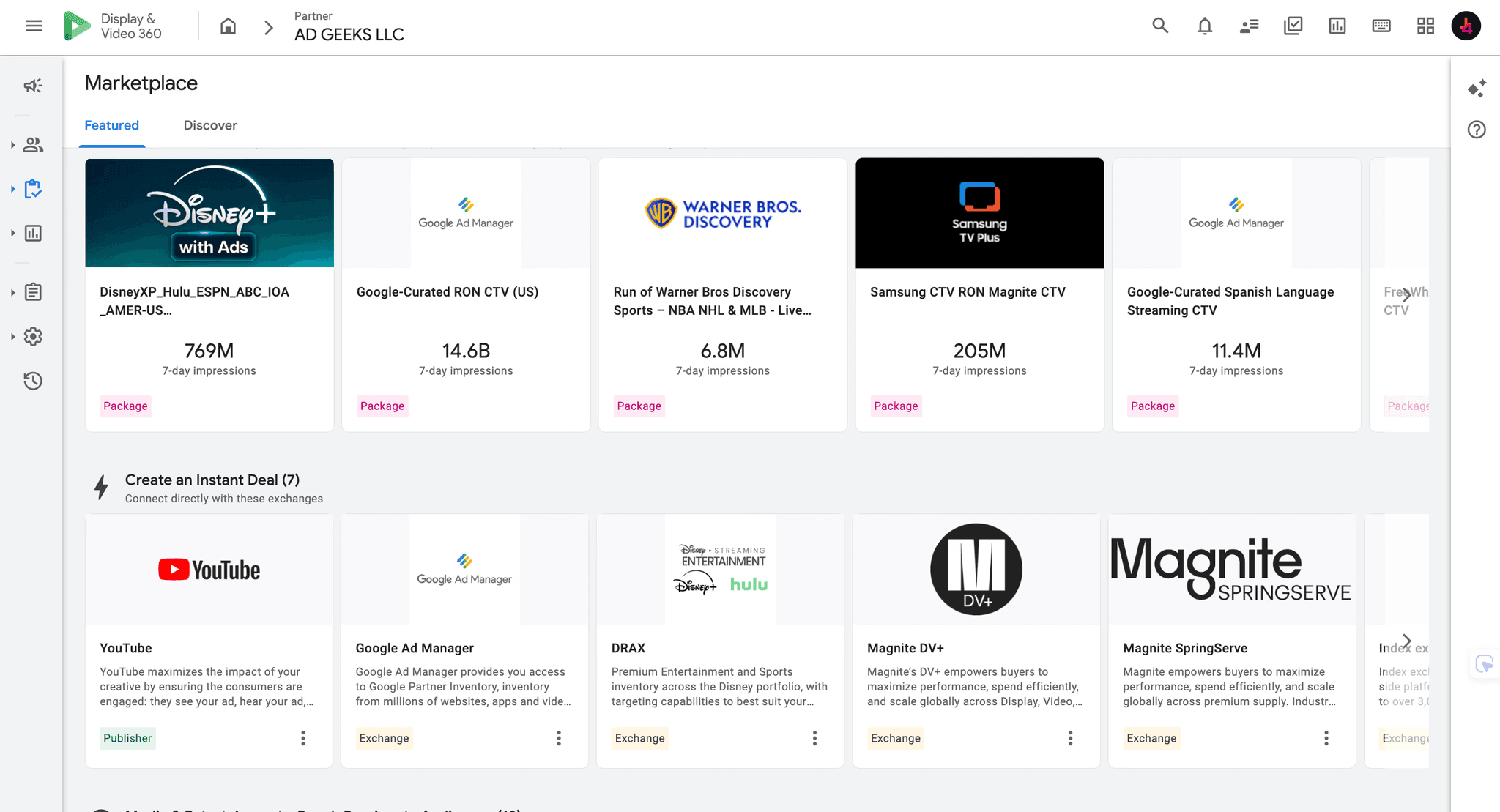
Ad Geeks holds Google Marketing Platform Partner status for Display & Video 360 and appears in Google's official Partner Directory alongside a listing in the Enterprise Marketing Portal. Google awards that designation against a bar covering technical capability, campaign management quality, and client service standards.
One practical consequence follows. Certified partners receive direct platform support, early access to beta features, and a seat structure that belongs to the client rather than to an intermediary reselling someone else's login. When a CTV flight breaks at two in the morning, the escalation path leads to a named engineer rather than a queue. The about page lists the operators behind those seats, and our guide to getting DV360 access in 2026 walks through the criteria the platform owner applies.
Three Enterprise Platforms
Most agencies recommend the platform they happen to hold. Running more than one removes that bias, since the recommendation follows the objective rather than the inventory of available logins. The table below sets out where each platform's models contribute most.
Platform | Where the models contribute most | Best suited to |
|---|---|---|
Google DV360 | Google audience and bidding models across YouTube, streaming inventory and connected TV | Maximum reach and full-funnel video |
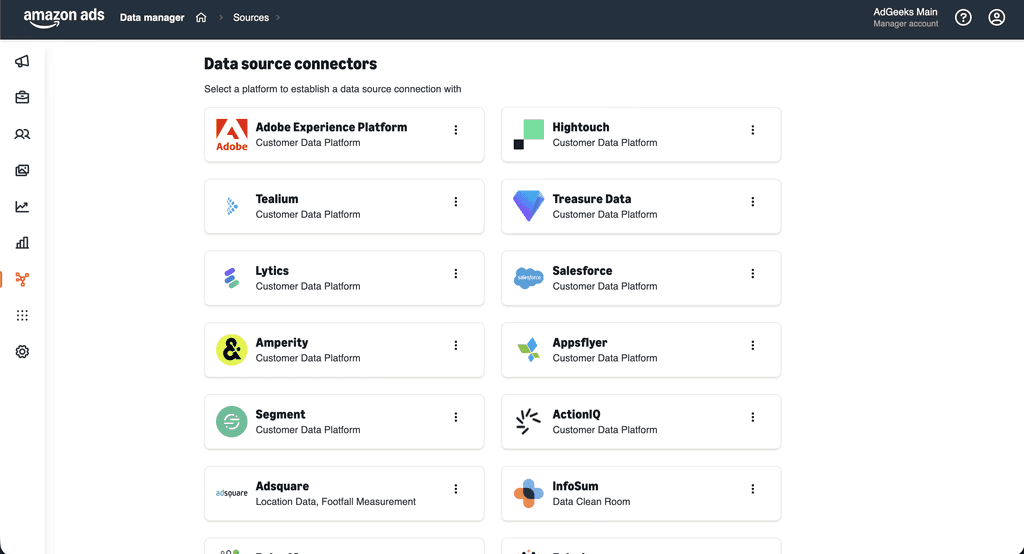
Amazon DSP | Deterministic purchase signal, activated on and off Amazon | Retail, eCommerce and new-to-brand growth |
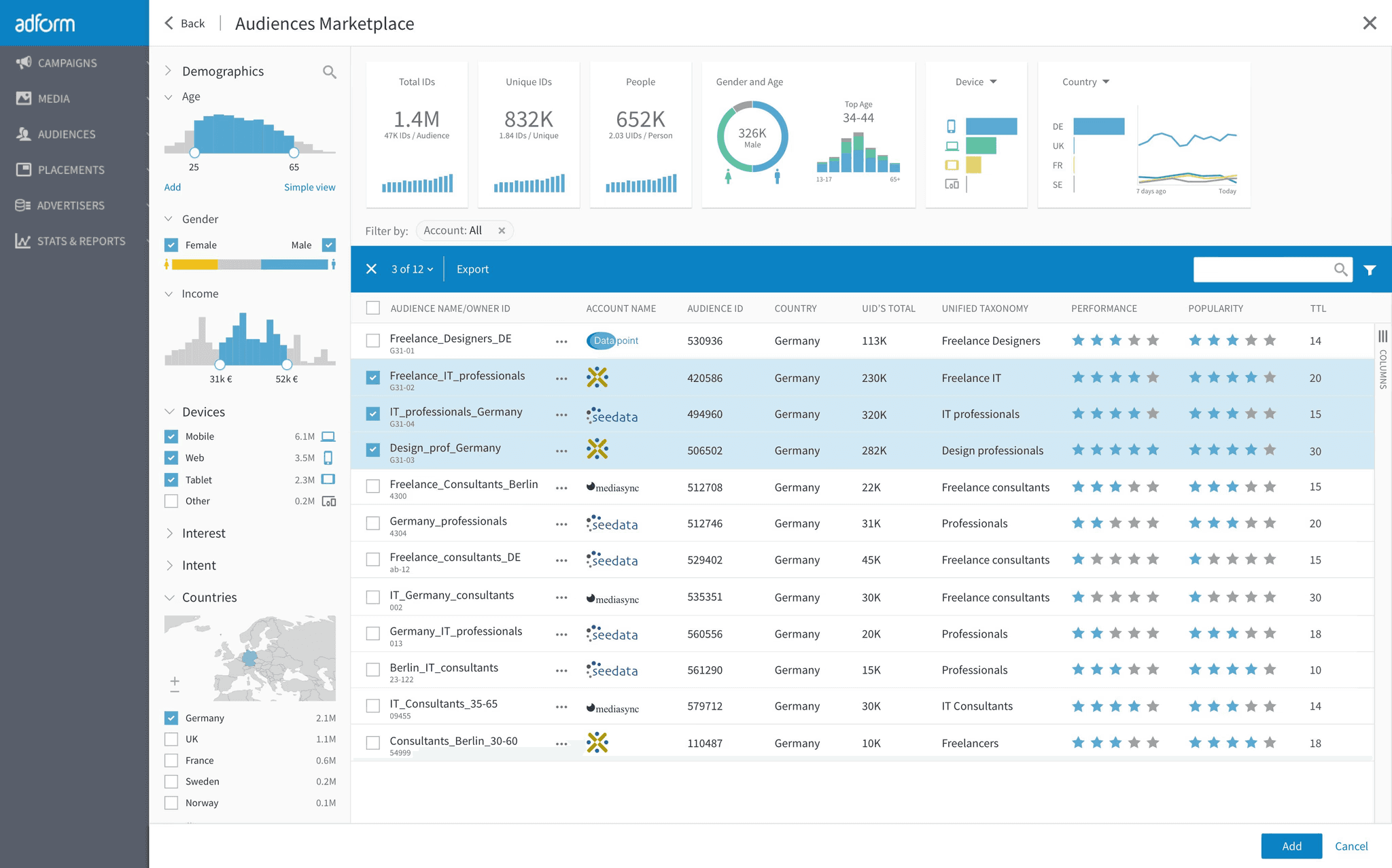
Adform | Cookieless identity resolution built for consent-first regimes | European and regulated markets |
Many clients run two platforms. Some run all three with audiences and frequency coordinated across them rather than competing for the same impression, an operating model covered in detail in the multi-DSP matrix. For advertisers weighing the Google stack specifically, why DV360 outshines Google Ads covers the comparison, five key benefits of DV360 summarises the case, and DV360 integrations with other Google Marketing Platform tools maps the data connections that feed the bidding models.
Advertisers displaced by the Xandr shutdown face a narrower set of options, addressed in our note on why DV360 became the strongest alternative for US advertisers. Regional partner selection sits in the European DV360 guide and the UK counterpart.
Where the Models Do the Work
AI-driven remains the most overworked phrase in ad tech, so the unglamorous version is worth stating. Four processes carry the automation on an Ad Geeks account.
Audience Modeling
Seed lists and first-party signals expand through platform lookalike and in-market models, then get pruned against recorded conversion data rather than assumed personas. Segments that stop converting lose budget inside the flight rather than at the post-mortem. The mechanics sit in our guide to audience segmentation in DV360 for higher ROI.
Bid Optimization
Automated bidding gets configured against the business outcome, never the vanity metric, with guardrails on frequency, viewability, and inventory quality. Those guardrails keep the algorithm optimizing toward margin instead of toward cheap impressions, which is the failure mode that makes automated buying look ineffective. Common mistakes in DV360 setup document the configuration errors that produce it.
Creative Sequencing
Format and message match funnel position. Video and connected TV carry the story, native and display carry the reminder, audio reaches attention without a screen, conversational units qualify a lead through two-way exchange, and in-app placements deliver full-screen impact inside mobile environments. Recent output sits in the creative showroom, with format guidance in best practices for video advertising in DV360.
Measurement
Automated reporting surfaces the shifts a weekly PDF would bury, which moves optimization into the flight rather than after it. That reporting discipline matters more as agentic systems take over pacing decisions, and it is the reason cross-platform measurement rose eight points among IAB respondents in a single year. Our notes on DV360 reporting metrics that matter, programmatic campaign delivery fixes, and the display and video underperformance audit cover the diagnostic side.
Channels the Models Optimize Against
Automation only performs against inventory a seat reaches. Ad Geeks runs across YouTube for video scale, Netflix and wider connected TV for premium streaming reach, Spotify for programmatic audio, and out of home for physical footfall against digital targeting.
Streaming has absorbed the sharpest share gains. IAB forecasts connected TV growth of 13.8% for 2026 against a 1.7% decline in linear television, a divergence traced in connected TV as the fastest-growing channel in digital media, the US tipping point analysis, and the UK growth picture. Household-level precision on that inventory sits in our note on CTV geofencing, with the full channel primer in the CTV advertising agency guide.
Audio and event-led planning follow the same logic. Advertising on Spotify through DV360 and Adform sets out the audio buying routes, while the World Cup 2026 vertical activation plays and the matching CTV playbook handle the tournament calendar that IAB expects to cushion linear decline this year.
Results That Survive Scrutiny
Platform fluency shows up in recorded outcomes rather than in a pitch deck. Three campaigns across different objectives and markets illustrate the range.
Campaign | Platform | Recorded result |
|---|---|---|
Dell, European account-based targeting | DV360 | 95% account list match rate, 75% engagement rate |
FootMender, three-market launch | Amazon DSP | 3.37M impressions, 520K+ new-to-brand shoppers |
Gulf, QR payment adoption | DV360 | 88,000+ app page visits, 12,000+ installs |
The Dell ABM campaign matched a curated account list against DV360 inventory at a 95% rate, reaching IT Decision-Makers and Procurement Managers across the full European market rather than a geo-restricted subset. The FootMender launch sequenced Prime Video and Fire TV awareness into display retargeting across the UK, France, and Germany over 60 days. The Gulf app-first campaign moved three distinct behavioural segments toward a single action inside a two-week promotional window.
Further records cover new-to-brand acquisition on Amazon DSP, subscription growth through streaming bundles, financial services ABM, developer-audience traffic work, and geo-targeted EV charging demand.
Access in Days, Not Months
Direct DV360 or Amazon DSP access typically demands enterprise minimums in the $50,000 to $200,000 monthly range, plus a procurement cycle that outlasts most campaign windows. The gap that creates for mid-market advertisers is the reason Ad Geeks exists. Three points define the alternative.
Seats generally go live within 48 to 72 hours of contract and strategy sign-off
No enterprise minimum spend applies
Fully managed and self-service models both available, matched to in-house capacity
Teams with existing programmatic talent receive the keys and ongoing support. Teams without it hand over the whole operation. Advertisers moving from an incumbent partner should read how to switch to a new programmatic agency before signing anything, and newcomers to the platform will find the sequence in how to start with DV360 and the step-by-step first campaign guide.
Built for Regulated and Competitive Categories
Programmatic gets harder the moment compliance enters the room, and no bidding model resolves a regulatory question on its own. Ad Geeks runs campaigns across technology, gambling and iGaming under UKGC, MGA and AGCO frameworks, finance, healthcare and pharma within HIPAA, GDPR-Health and national pharma codes, retail and eCommerce, tourism and travel, hospitality, and B2B.
Brand safety, inventory allow-lists, and consent handling get configured before the first impression serves rather than after the first complaint. Sector-specific guidance sits in the B2B programmatic partner explainer and the programmatic display guide for global brands, with the operational baseline in best practices in programmatic advertising. Data handling terms sit in the privacy policy and terms and conditions.
How to Test an AI-Driven Claim
Four questions separate a working automation stack from a positioning line, and any credible partner answers all four without hesitation.
Which specific outcome does the bidding algorithm optimize toward, and who set that target?
What guardrails limit the model on frequency, viewability, and inventory quality?
How often does audience composition get pruned against recorded conversions rather than assumed personas?
Does the seat belong to the advertiser, and does log-level data come with it?
A partner who answers the fourth question with a shrug is reselling access rather than running a platform. Agency size comparisons for both ends of the market sit in best programmatic agencies for small businesses in 2026 and best programmatic agencies for enterprise brands in 2026.
Frequently Asked Questions
What makes an agency AI-driven in programmatic advertising?
Machine learning runs the bidding, audience expansion, and delivery decisions in real time, while strategists set the objectives, guardrails, and creative logic those models optimize against. The difference between a working AI-driven agency and a marketing claim comes down to whether the team explains what the algorithm optimized toward and shows the supporting data.
Does an AI-driven programmatic agency require a large budget?
No. Direct enterprise DSP contracts often require $50,000 to $200,000 per month in minimum spend. Ad Geeks provides access at a fraction of that figure and structures campaigns around the budget available. Start with the request access form.
How long does a programmatic campaign take to launch?
Seats are typically ready within 48 to 72 hours of contract signature and strategy alignment. Media goes live inside the first week, an onboarding speed the about page commits to publicly.
Which DSP should a brand use?
DV360 suits maximum reach, YouTube, and connected TV. Amazon DSP wins where first-party purchase data drives the outcome. Adform fits privacy-first, cookieless, and European campaigns. Most brands benefit from a combination, and the recommendation follows the objective on the intro call. Detail on each sits across the DV360, Amazon DSP and Adform pages.
Is Ad Geeks a certified Google partner?
Yes. Ad Geeks holds Google Marketing Platform Partner status for Display & Video 360 and appears in Google's official partner directory. Both listings are linked from the about page.
Getting Started
An AI-driven programmatic agency is worth only as much as the access it holds, the data it feeds the models, and the people reading the output. Ad Geeks brings certified access to three enterprise platforms, automated buying across display, video, CTV, audio, and native inventory, and a team reachable without a ticket queue. Ongoing analysis sits in news and insights.
To see what managed access looks like against your own media plan, talk to the Ad Geeks team.