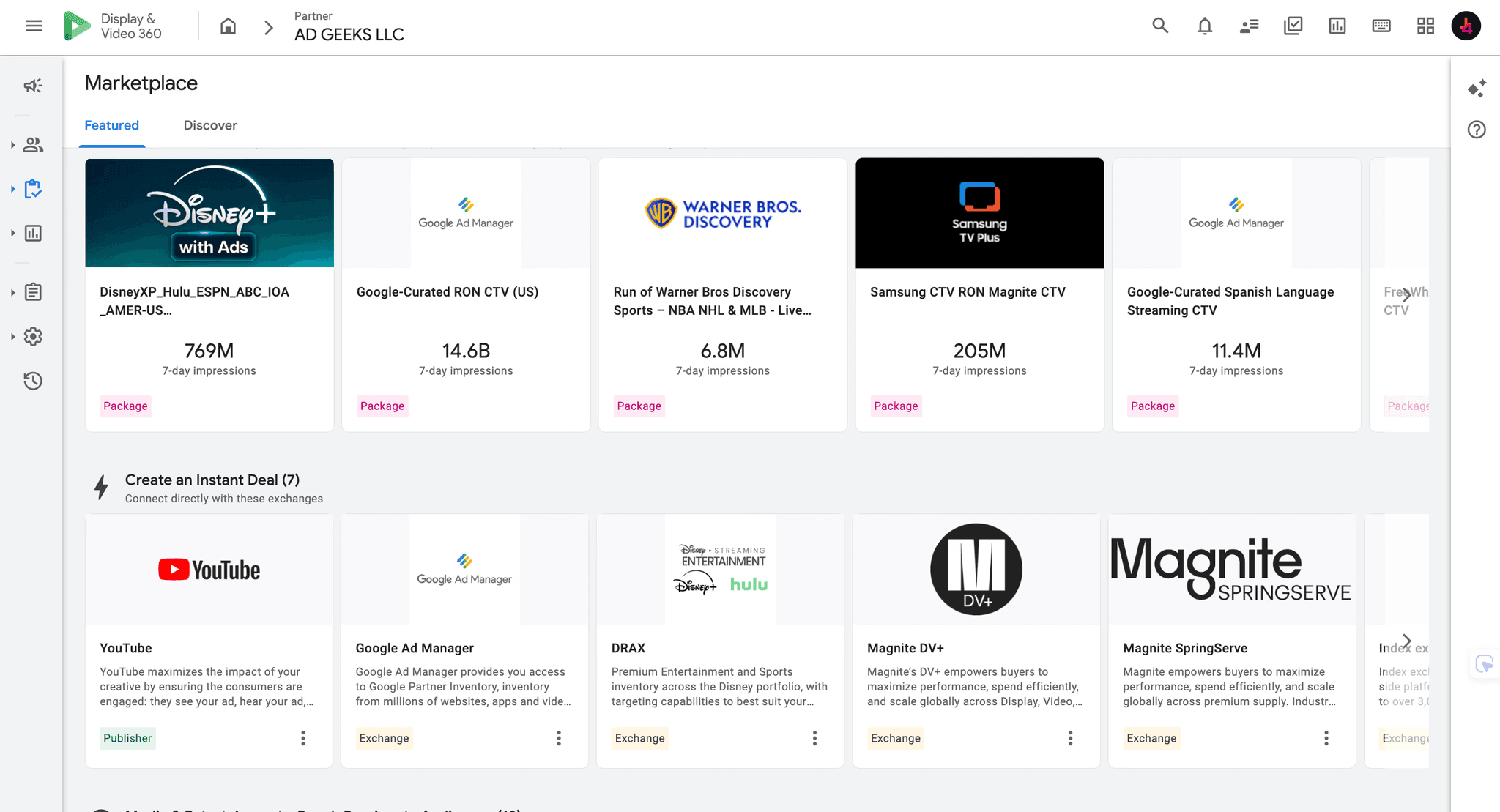
Display & Video 360 puts a UK advertiser one seat away from YouTube inventory and the streaming environments where British viewing has settled. Google sells that seat as an enterprise product, which in practice means a long contract and a monthly commitment most independent agencies never reach. Onboarding runs in months. A DV360 agency closes that gap by holding the seat on your behalf and turning access around in days rather than quarters.
The partner you pick then decides what the seat is worth. British media buying carries a compliance load that shifted twice in the past year, and a team that treats UK targeting as a copy of its European setup will find out the hard way. What follows sets out how the UK market reads in 2026, what a managed partner has to carry here, and where AdGeeks fits for brands and agencies that want Google premier DSP without the enterprise terms.
The UK Market a DV360 Seat Is Bidding Into
Britain runs the most digitised ad market in Europe, and the scale of it frames every platform decision that follows. IAB UK put total digital ad spend at £40.5 billion for 2025 in its Digital Adspend study with Oliver Wyman, growth of ten percent against UK GDP growth of 1.4 percent over the same period.
Video did the heavy lifting inside that total. Investment climbed 20 percent to £9.3 billion and took 23 percent of all digital spend, with TV+ formats accounting for 34 percent of the video pot. Marketing Week reported the study forecast of £44.7 billion for 2026, rising to £49.1 billion the year after. Mobile absorbed 71 percent of spend, which shapes how creative gets built long before a bid strategy is set.
Read those figures as an instruction rather than a headline. The inventory worth holding in the UK is video inventory, which is precisely where bidding discipline separates a competent seat from an expensive one. Our guide to video advertising in DV360 covers how that discipline is applied at campaign level, and the UK Connected TV picture explains why streaming is pulling budget faster than any other channel here.
Out-of-home followed the same automation curve, with digital OOH up 11 percent to £1.1 billion. Buying those screens through the same seat as display keeps frequency honest, which is the argument for running programmatic out-of-home inside a single platform rather than through a separate specialist.
Access Is the First Obstacle, Not the Strategy
Most UK teams meet the same wall before a single line item exists. Direct DV360 contracts carry minimum spends that AdGeeks puts at roughly $50,000 to $200,000 per month, a threshold that rules out mid-market brands and the independent agencies serving them. A managed-seat partner pools that access, so you reach identical inventory and identical controls with none of the contractual weight.
Speed is the second half of the same problem. A launch window tied to a retail season will not wait for procurement, and AdGeeks moves setup down to a 48 to 72 hour turnaround once the strategy is agreed. If you want the mechanics before you commit, our walkthrough on how to get DV360 access sets out the route in full, and how to start with DV360 covers what the first weeks demand from your team.
Management model is the decision that follows access. Some UK advertisers want the seat and nothing else, having built programmatic capability in-house. Others hand over strategy and optimisation entirely. Both models sit inside the same agreement at AdGeeks, and our comparison of DV360 campaign management services lays out where each one earns its keep. Teams already running a seat badly will find more value in the underperformance audit and the delivery fixes guide.
The UK Compliance Load a DV360 Partner Has to Carry
British rules diverged from the European set after Brexit, and a partner applying one playbook across both will misread the difference. UK GDPR governs personal data, while the Privacy and Electronic Communications Regulations govern what a browser stores before consent. The Information Commissioner Office enforces both, and UK GDPR breaches carry maximum penalties of £17.5 million or four percent of global annual turnover.
That regime is in motion. The Data (Use and Access) Act 2025 created new consent exemptions, and in July 2025 the ICO opened a consultation on risk-based PECR enforcement for online advertising, proposing that low-risk functions such as fraud prevention operate without prior consent. Law firm Skadden documented the proposal and the August 2025 consultation close, with Clifford Chance noting the ICO intent to publish a list of advertising activities unlikely to attract enforcement. Nothing here is settled, which is exactly why audience configuration on a UK seat needs someone tracking it monthly.
One change already bites. From 5 January 2026, section 368Z14 of the Communications Act 2003 prohibits paying for online advertisements for an identifiable less healthy food or drink product, a restriction confirmed on legislation.gov.uk and guided by CAP. Businesses meeting the SME definition sit outside the ban. Everyone else running food or drink creative through a UK seat needs product identifiability checked at asset level before the campaign goes live, not after the ASA asks.
Sector rules stack on top of all that. Operators advertising to British bettors answer to the UK Gambling Commission, financial promotions carry their own approval chain, and pharmaceutical creative works inside codes that differ from the European equivalents. A generalist buyer applies one approach to all three and finds the gap during an investigation.
Formats a UK DV360 Seat Should Cover
Channel coverage separates a genuine DV360 operation from a reseller with a login. The table below maps the formats AdGeeks runs from a single seat and the job each one does inside a British media plan.
Format | Role in a UK campaign | Where the impressions sit |
|---|---|---|
Carries the format taking 23 percent of UK digital spend, from pre-roll through to living-room streaming | YouTube, broadcaster streaming, premium publishers | |
Builds reach across the open web and holds frequency steady between video bursts | UK publisher inventory and private marketplace deals | |
Matches editorial surroundings, which lifts attention on quality UK news and lifestyle sites | Sites and apps across the open web | |
Reaches commuters and listeners with no screen involved | Spotify, podcasts, streaming radio | |
Delivers full-screen impact on the devices carrying 71 percent of UK digital spend | Mobile app inventory | |
Turns a placement into a two-way exchange that qualifies the lead before the click | Interactive placements |
Streaming deserves its own line of thinking. Household-level reach across Netflix, YouTube and broader Connected TV inventory now carries precision that used to belong to display alone. Our CTV advertising agency guide covers what to expect from a partner in this channel, while CTV geofencing explains the household-level targeting behind it. Audio works on the same logic, and our breakdown of advertising on Spotify through DV360 and Adform shows how the buy is structured.
Sector Depth Across the UK Verticals
Regulation and audience behaviour vary sharply by industry in Britain, so AdGeeks structures delivery around named verticals rather than one template. The list below shows what that specialisation looks like in the UK market.
Technology reaches Software Developers, IT Decision Makers, and enterprise procurement teams through high-authority tech publications and account-based targeting.
B2B handles long sales cycles and multi-stakeholder buying committees, with the approach set out in our guide to the B2B programmatic partner model.
Gambling & iGaming runs inside the UK Gambling Commission framework, with premium placement quality held throughout.
Finances reaches high-net-worth individuals and banking customers through brand-safe inventory at the standard the regulator expects.
Healthcare & Pharma supports both direct-to-consumer and healthcare-professional campaigns inside country-specific pharma codes.
Retail & eCommerce reaches shoppers at the point of intent, with less healthy food restrictions screened at creative level.
Tourism & Travel maps display for inspiration and video for destination storytelling, closing with retargeting at the booking stage.
Hospitality drives direct booking revenue for independent hotels and chains rather than feeding the online travel agencies.
What UK Delivery Looks Like in Practice
Geo-targeting shows the platform at its sharpest, and a campaign for BP Pulse makes the case with British numbers. The EV charging network needed to lift usage at underused stations while growing app adoption, so radius targeting of one to three kilometres was applied around charging locations, with London carrying the highest impression density alongside the M25 corridor.
Google EV affinity segments filtered out non-EV drivers inside those radii, and first-party CRM data added a retargeting layer that re-engaged lapsed app users. Display creative carried station-level calls to action such as a prompt to recharge near Canary Wharf, tying each impression to a location the driver reached within minutes. Six-second YouTube bumpers handled the proximity message in non-skippable form. Delivery produced an 11 percent lift in station visits, a 0.55 percent click-through rate, and 8,500 app downloads. The full breakdown sits in the BP Pulse case study.
Account-based work shows a different edge of the same platform. A Dell campaign across Europe matched a curated account list against programmatic inventory at a 95 percent match rate and produced a 75 percent engagement rate among targeted decision-makers, detailed in the Dell ABM case study. Streaming subscription work for Verizon generated more than 42,000 bundle sign-ups at a 61 percent video completion rate, set out in the streaming bundles case study. The wider case studies library and the creative showroom hold the rest.
Five Questions to Put to a DV360 Agency in UK
Shortlisting gets easier once the questions get specific. These five surface the difference between an operator and an intermediary.
How fast does access happen? A partner quoting months is reselling the barrier you approached them to remove. Compare answers against the enterprise programmatic agency shortlist.
Who runs the campaign day to day, and does that model flex as your in-house capability grows?
How is UK GDPR and PECR consent handled inside audience setup, and who tracks the ICO position as it changes?
Which reporting does the partner commit to, and against which metrics? Our piece on DV360 reporting metrics that matter gives you the benchmark to hold them to.
What does the exit look like? Data portability and seat handover terms decide how expensive a bad fit becomes, which our guide on switching to a new programmatic agency addresses directly.
Newer teams benefit from groundwork before those conversations start. The five key benefits of DV360 article covers the platform case, DV360 against Google Ads answers the question most brands ask second, and the common mistakes in DV360 setup piece flags what goes wrong early. For build detail, see the step-by-step first campaign guide, the notes on audience segmentation, and the overview of Google Marketing Platform integrations.
Where DV360 Stops and the Rest of the Stack Starts
One DSP rarely answers every brief. Retail advertisers reaching British shoppers gain from purchase behaviour that only Amazon DSP holds, while privacy-first and cookieless UK campaigns often route better through Adform, the leading independent European DSP. Advertisers displaced by the Xandr closure have a separate set of options, covered in our note on why DV360 became the strongest alternative.
Running all three through one partner removes two contracts and one round of reconciliation. Our programmatic display guide for global brands covers multi-market structure, the European DV360 partner guide handles the continental side for brands buying across both, and best practices in programmatic advertising sets the operational baseline. Sport-led planning for the season ahead sits in the World Cup 2026 activation plays and the matching CTV playbook.
Getting Started
A DV360 agency in the UK earns its place by removing the enterprise barrier and carrying the British compliance load that follows. AdGeeks holds the seat, scales management to whatever your team already does well, and brings vertical depth built around the rules British advertisers answer to. More on the team sits on the about page, with ongoing analysis in news and insights.
To see what managed access looks like against your own media plan, talk to the AdGeeks team.