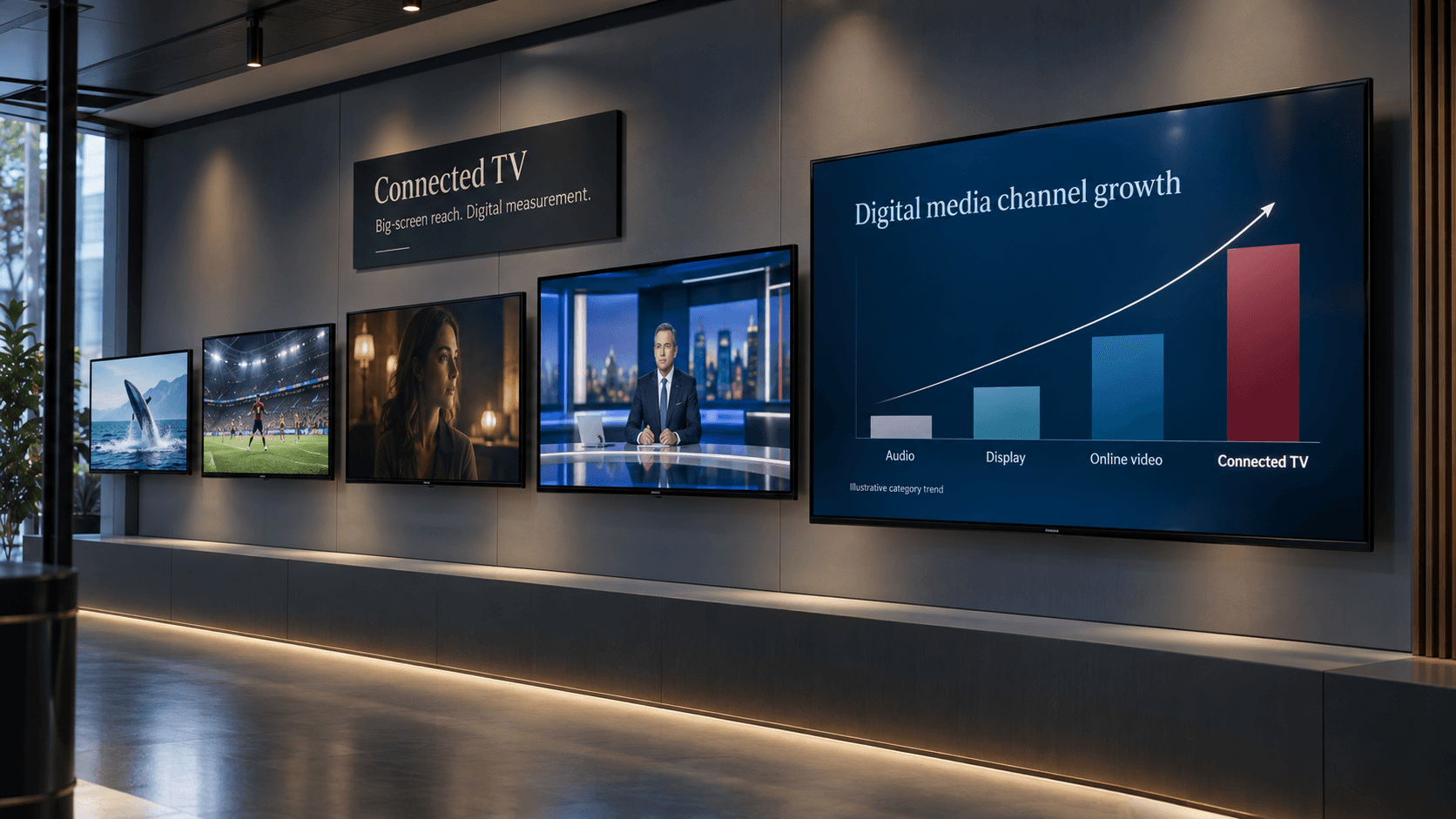

Streaming now accounts for nearly half of all US television viewing, according to Nielsen’s The Gauge. That shift has been building for years, but 2025 was the tipping point: for the first time, streaming surpassed broadcast and cable combined. The audience has moved. And advertising budgets are following, with US connected TV ad spending projected to reach approximately $38 billion in 2026. No other major advertising channel is growing at that pace.
Why CTV Ad Spend Keeps Climbing
The spending surge reflects something deeper than a trend. Nine in ten US households now use a connected TV device at least once per month, and that penetration rate continues to rise. Viewers are not splitting time evenly between traditional and streaming formats – they are leaving linear television behind. Cable’s share of total TV time has dropped below a quarter, and broadcast sits around a fifth.
Advertisers are reacting to that shift with growing confidence. A 2026 survey by Advertiser Perceptions and Premion found that seven in ten CTV advertisers plan to increase spending this year. The top motivation is the ability to reach engaged opt-in audiences who have actively chosen what to watch. A close second is combining television’s branding scale with the targeting precision of digital channels.
CTV Advertising as a Full-Funnel Performance Channel
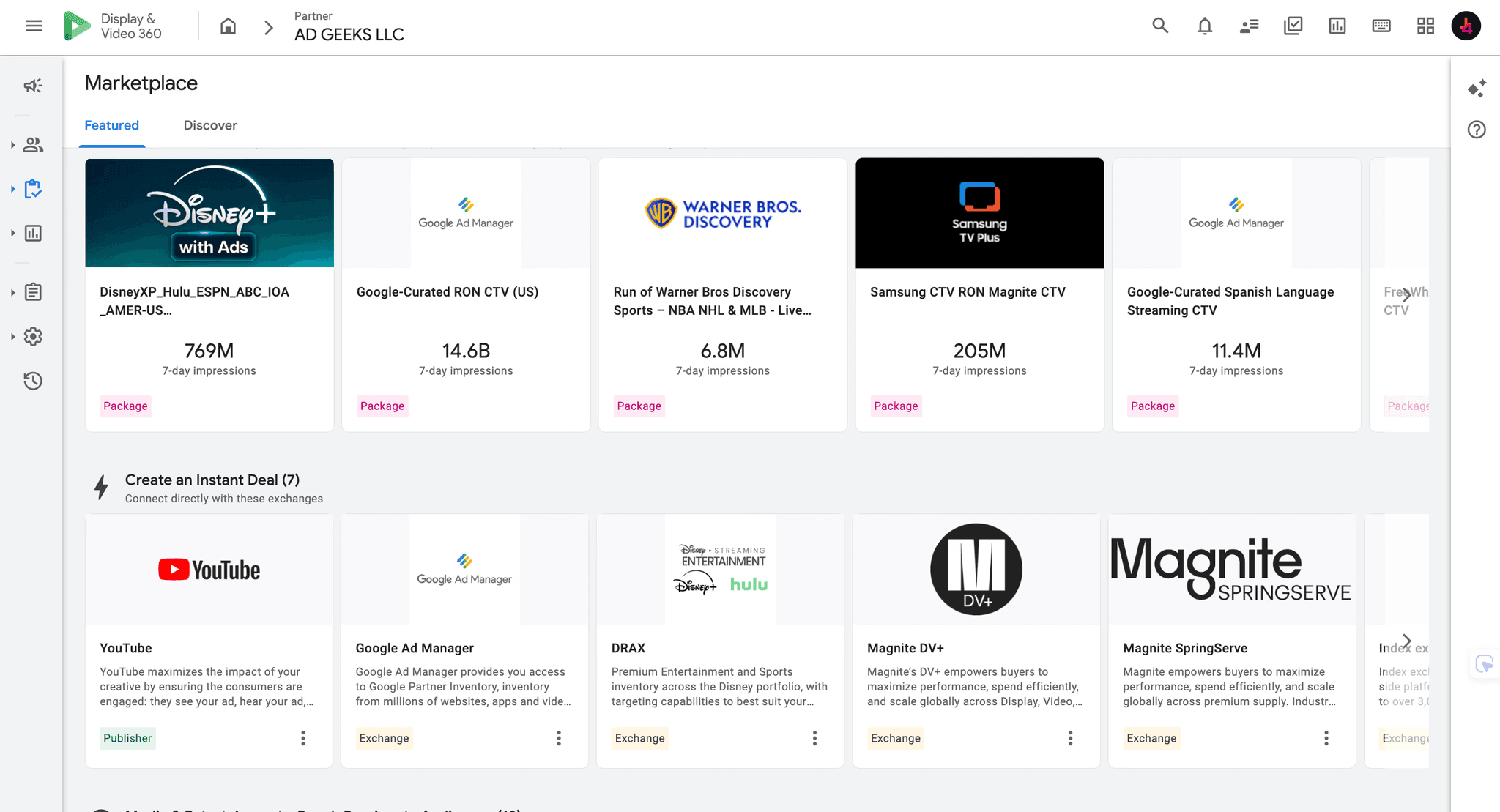
Connected TV started as an awareness play. That framing no longer holds. Through demand-side platforms such as Google Display & Video 360, brands now activate campaigns with household-level ad delivery, geo-targeting by city or service area, and audience segments layered on third-party data covering purchase intent, income, health interests, and lifestyle indicators. Frequency controls and cross-device measurement add a level of precision that traditional television was never built to deliver.
Interactive formats are expanding the channel’s role further down the funnel. QR code usage in CTV ads has grown significantly year over year, and shoppable ad units are converting at rates well above standard video placements. Advertisers overwhelmingly agree that adding CTV to an omnichannel campaign reinforces messaging and improves overall return. The channel is earning its place not as a replacement for digital performance media, but as a complement that warms audiences on the biggest screen in the house before retargeting reaches them on mobile.
Which Platforms Are Capturing CTV Ad Revenue
Platform | Main Services | Market Position |
YouTube (Google) | YouTube, YouTube TV | Largest share of CTV ad revenue |
Amazon | Prime Video, Fire TV, Twitch | Commerce-driven CTV ecosystem |
Disney | Hulu, Disney+, ESPN | Premium streaming inventory |
Netflix | Ad-supported tier | Rapidly expanding ad inventory |
Paramount | Paramount+, Pluto TV | Hybrid subscription + FAST inventory |
Retail Media Networks | Walmart Connect, Amazon Ads | Commerce data + CTV targeting |
Key insight
YouTube, Amazon, and Disney are projected to control ~33% of CTV advertising revenue in 2026, while retail media networks are emerging as a new growth driver.
Programmatic CTV Buying and the Role of AI
Programmatic transactions already account for the vast majority of CTV deals, and that share is expected to grow as automated buying becomes the default activation model. The IAB’s latest outlook identifies cross-platform measurement as a top-tier priority for buyers this year, reflecting growing pressure to connect AI-driven activation with outcome-based reporting.
AI is starting to reshape how campaigns run in real time. Real-time optimization ranks as the most valued AI application for CTV, though widespread availability is still catching up to advertiser expectations. The broader direction is clear: a growing majority of ad buyers plan to deepen their use of generative AI in media campaigns this year. That applies to creative production, audience segmentation, and in-flight performance adjustments.
CTV Advertising Challenges That Remain
Fragmentation remains the most persistent barrier to scaling CTV investment. Roughly a third of advertisers report difficulties with deduplicated reach and cross-provider planning, and more than half work with multiple CTV providers to piece together coverage across walled garden inventory. Measurement gaps reinforce the challenge: a majority of marketing decision-makers say they would increase CTV budgets if they had better ROI tracking and cross-screen effectiveness data.
Traditional TV metrics were not designed for app-based viewing on shared screens across fragmented platforms. Marketers are combining marketing mix models, incrementality tests, and brand lift studies, yet few have assembled these into one coherent measurement system. Closing that gap is what separates CTV as a promising channel from CTV as a proven performance driver.
What Brands Should Do Now
Linear TV’s share of ad spending continues its structural decline, and the dollars leaving that channel are flowing primarily into CTV and social video. Brands that establish a CTV presence while growth rates remain strong gain an edge over later entrants. Developing CTV-specific creative, learning which formats resonate on streaming platforms, and building cross-screen measurement frameworks all take time.
The market is expected to moderate in growth rate over the next few years, but the trajectory points toward CTV surpassing traditional TV ad spending entirely before the end of this decade. Advertisers that treat the channel as a measurable performance medium – rather than a passive extension of broadcast – are the ones capturing the most value from this shift.