
The FIFA World Cup 2026 arrives in Canada, Mexico, and the US as the largest single-sport event in history, and the ad stack that supports it looks nothing like the one that carried Qatar 2022. Live sports inventory that once required direct network deals and six-figure minimums is now biddable inside Display & Video 360, which changes who gets to show up on the biggest screen during the biggest matches. AdGeeks operates at the center of that shift as a DV360 partner. This piece lays out how we turn the tournament into working media for brands that want CTV reach without the enterprise contract barrier.
What Makes the 2026 World Cup a CTV-First Event
Google used its NewFronts stage to make a direct argument to advertisers: DV360 now reaches 98% of CTV households in the US and represents 5 billion hours of ad-supported watch time per month, roughly 40% more than The Trade Desk and 90% more than Amazon's DSP. Biddable inventory is growing twice as fast as programmatic guaranteed within DV360, and NBCUniversal's Ryan McConville described the shift as a "democratization of access" for advertisers with smaller budgets to bid on live content. For mid-market brands, the gatekeepers that walled off live sports have opened the gates, and the auction is now the front door.
YouTube sits inside that story as a second pillar. YouTube officially partnered with FIFA as a Preferred Platform for the FIFA World Cup 2026, unlocking extended highlights, behind-the-scenes footage, Shorts, and video-on-demand content. For the first time in the competition's history, Media Partners will have the option of live streaming the first 10 minutes of every match on their YouTube channel. That is 104 matches of opening-whistle footage flowing into feeds, search, and CTV apps simultaneously, all reachable through DV360.
What biddable live sports on DV360 gives advertisers
Google's January rollout introduced four mechanics that matter for World Cup planning, summarized below.
Feature | What it does | Why it matters for the World Cup |
|---|---|---|
Unified Reach and Personalization | Combines Google audience signals with NBCUniversal live sports CTV inventory | Targets, for example, Mexican expats in Los Angeles during a Mexico group-stage match without a direct-sold package |
Cross-device Frequency | Reads household-level signals across YouTube, Peacock, and open-exchange CTV | One cap governs the living room watching Argentina vs. Croatia, preventing the same spot running 11 times |
Cross-device Conversion | Connects a CTV impression to a purchase in real time, at no extra cost | Moves match-day campaigns from impression reporting to revenue attribution |
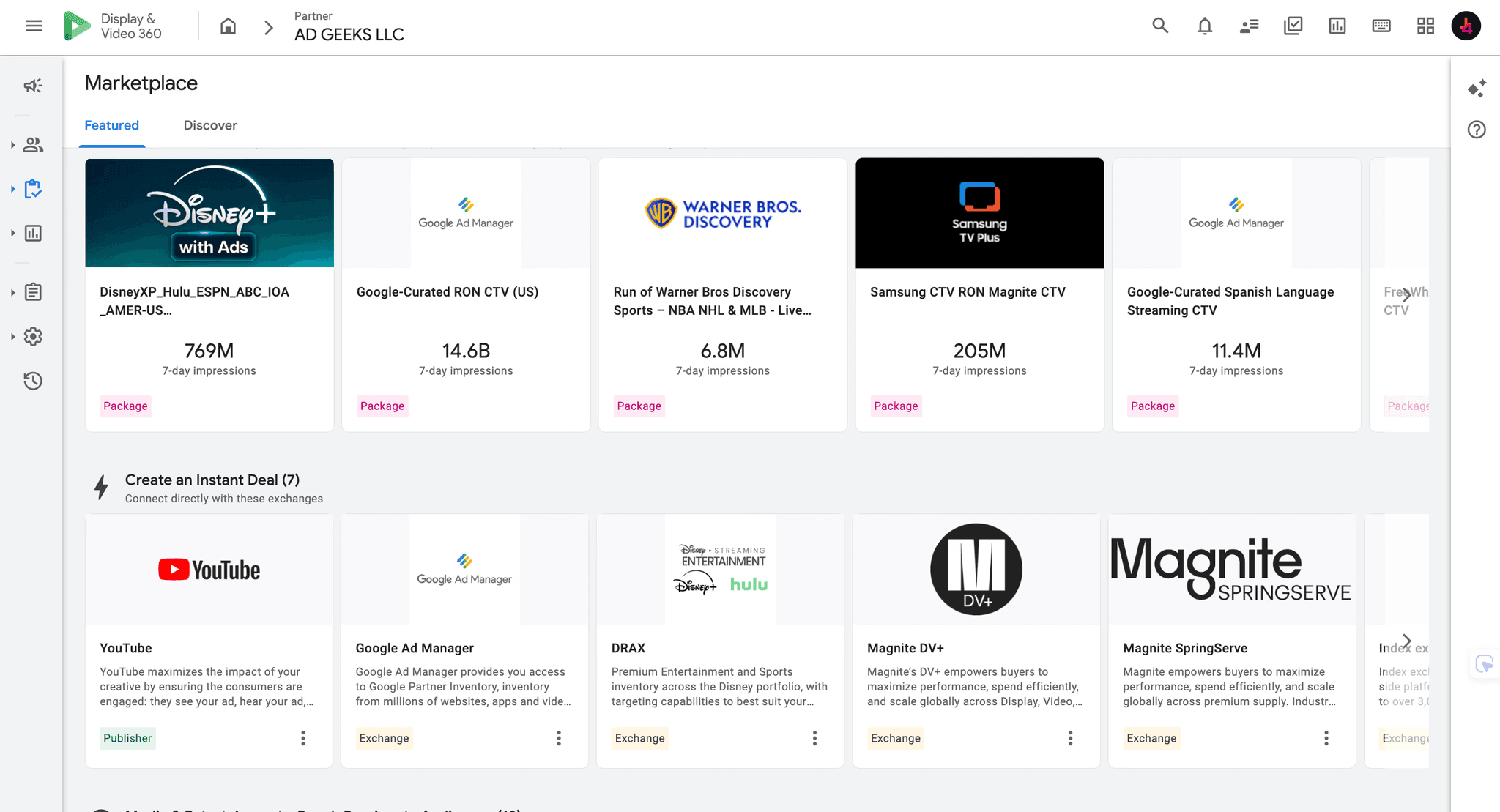
Marketplace packages | Curated live sports inventory activated in a few clicks | Teams pivot with fixture outcomes in 24 hours instead of renegotiating an insertion order |
YouTube and 3P CTV in one workspace
Fragmentation is the quiet tax on most live sports plans. Buying YouTube in one silo and third-party CTV in another hits the same household with overlapping frequency and inflates reach reports. Making Science's client data shows cross-channel frequency capping saves upwards of 15 to 20% of media spend by eliminating redundant impressions. DV360 uses Google's identity signals to deliver a consolidated view of unique reach, and audience design collapses from two workflows into one Video Audience built across YouTube and premium CTV.
How AdGeeks runs a World Cup activation on DV360
We compress the inventory, features, and audience logic above into a four-stage structure a client can approve and launch in days.
Pre-tournament priming starts six to eight weeks before kickoff. YouTube carries the load because FIFA's digital archive drives search and watch behavior before the first whistle. Bumper ads and 15-second skippables against archive content, creator reactions, and national-team previews build custom intent audiences that feed the live phase.
Match-window activation runs the biddable CTV layer. We define fixture-adjacent dayparts, pair them with curated Marketplace packages, and layer demographic and behavioral signals relevant to the vertical. A FinTech client targeting young urban viewers runs different line items than a Tourism & Travel operator reaching families planning a trip to a host city.
Real-time optimization is where biddable pays off. Group-stage surprises shift viewership sharply inside a 24-hour window. Biddable packages activate in clicks, so we reallocate toward trending fixtures without losing flight efficiency.
Post-match amplification closes the cycle on YouTube. Extended highlights and Shorts keep matches relevant for 48 hours, which is where cross-device conversion tracking typically registers the heaviest purchase signal for retail, iGaming, and hospitality clients.
Forget the funnel during live sports
Google's own framing makes this explicit. Consumer behavior is a series of overlapping and often simultaneous activities: streaming, scrolling, searching and shopping, and the old definition of CTV no longer applies. A fan watches the second half on a smart TV, checks the bracket on a phone, searches for a player's jersey during halftime, and books a flight to a host city the next morning. The World Cup is the clearest real-world test of that overlap, which is why we build plans that treat awareness, consideration, and conversion as concurrent rather than sequential.
AdGeeks and the 2026 window
The tournament is a 39-day compression of global attention, and the programmatic infrastructure to capture it no longer sits behind a holding-company wall. AdGeeks gives brands DV360 access in days rather than months, with hands-on campaign management across biddable live sports, YouTube, and the full CTV stack. The platform decisions made in the next 60 days will define how efficiently your budget performs during the tournament.
We will scope a World Cup-ready DV360 activation for your brand.