The best iGaming programmatic agency is not simply the buyer with the longest inventory list. It is the partner that can prove where it may advertise, how it will prevent ineligible delivery and which acquisition event will control optimization after the click.
For a licensed operator, that usually means 5 things: market-by-market compliance, approved DSP and publisher access, legal-age and exclusion controls, clean conversion tracking and optimization beyond registration toward first-time deposit and player value.
This comparison reviews 5 agencies and agency-style media partners with public evidence relevant to iGaming acquisition. Some are programmatic specialists. Others combine programmatic with search, social, native or alternative traffic. The right shortlist depends on the operator's licences, markets and measurement needs.
Quick answer: Ad Geeks is the strongest fit in this comparison for operators that need managed enterprise DSP access, European market execution and published Adform proof tied to registrations and first-time deposits. TBD.Media is a strong specialist for iGaming display and video. Vertoz adds programmatic, mobile OEM and alternative traffic. Basher Agency suits broader multichannel acquisition. MediaTroopers is relevant to regulated North American buying, but buyers should verify its current programmatic stack and reporting depth in the pitch.
How we evaluated iGaming programmatic agencies
“Best” needs a job description. We reviewed public first-party pages against 6 criteria that affect real campaign delivery.
Regulated-market fluency. Does the partner treat every licence, product and jurisdiction as a separate approval problem?
Programmatic access. Does it name DSPs, buying routes, formats or inventory rather than using “programmatic” as a broad label?
Compliance operations. Can it apply age, geography, exclusion, creative, scheduling and publisher controls?
Player-acquisition measurement. Does optimization reach registration, first-time deposit and downstream value rather than stop at clicks?
Market fit. Is the public offer built for Europe, North America or a wider multi-market brief?
Evidence. Is there a relevant case study, disclosed operating model or specific public capability page?
Public pages cannot confirm what a team can access for a specific operator. DSP approval, publisher acceptance and inventory availability can change by market and product. Treat this list as a shortlist, then verify every claim in writing.
Best iGaming programmatic agencies at a glance
Agency or partner | Best fit | Publicly visible programmatic angle | Verify before appointment |
|---|---|---|---|
AdGeeks | Managed enterprise DSP buying, European iGaming and FTD-focused acquisition | Adform, DV360 and multi-DSP capability; published Maxwin Adform case | Approval for the operator, product, market and inventory in scope |
TBD.Media | Specialist iGaming display and video | In-house DSP, sports and entertainment inventory, age-gating and geo-fencing | Seat ownership, supply paths, log access and fee waterfall |
Vertoz | Programmatic plus mobile OEM and alternative traffic | Display, native, video, CTV, mobile OEM and parked-domain options | Source-level quality, inventory acceptance and player-value feedback loop |
Basher Agency | Multichannel casino and sportsbook acquisition | Programmatic display alongside paid social, search and native | Direct versus reseller DSP access and jurisdiction-specific proof |
MediaTroopers | Regulated US and Ontario sportsbook media buying | Digital media buying with substantial public licensing coverage | Current DSP stack, programmatic operating model and event-level reporting |
1. AdGeeks - best for managed Adform access and FTD-focused proof
AdGeeks is the clearest programmatic-first choice in this shortlist when the brief combines regulated-market execution, enterprise DSP access and acquisition measurement below registration.
The Ad Geeks iGaming solution is built around licensed-market campaigns, adult audience controls, responsible-gambling requirements and premium sports, news and entertainment inventory. Its broader platform offer includes Adform, DV360, The Trade Desk and other managed buying routes where approved.
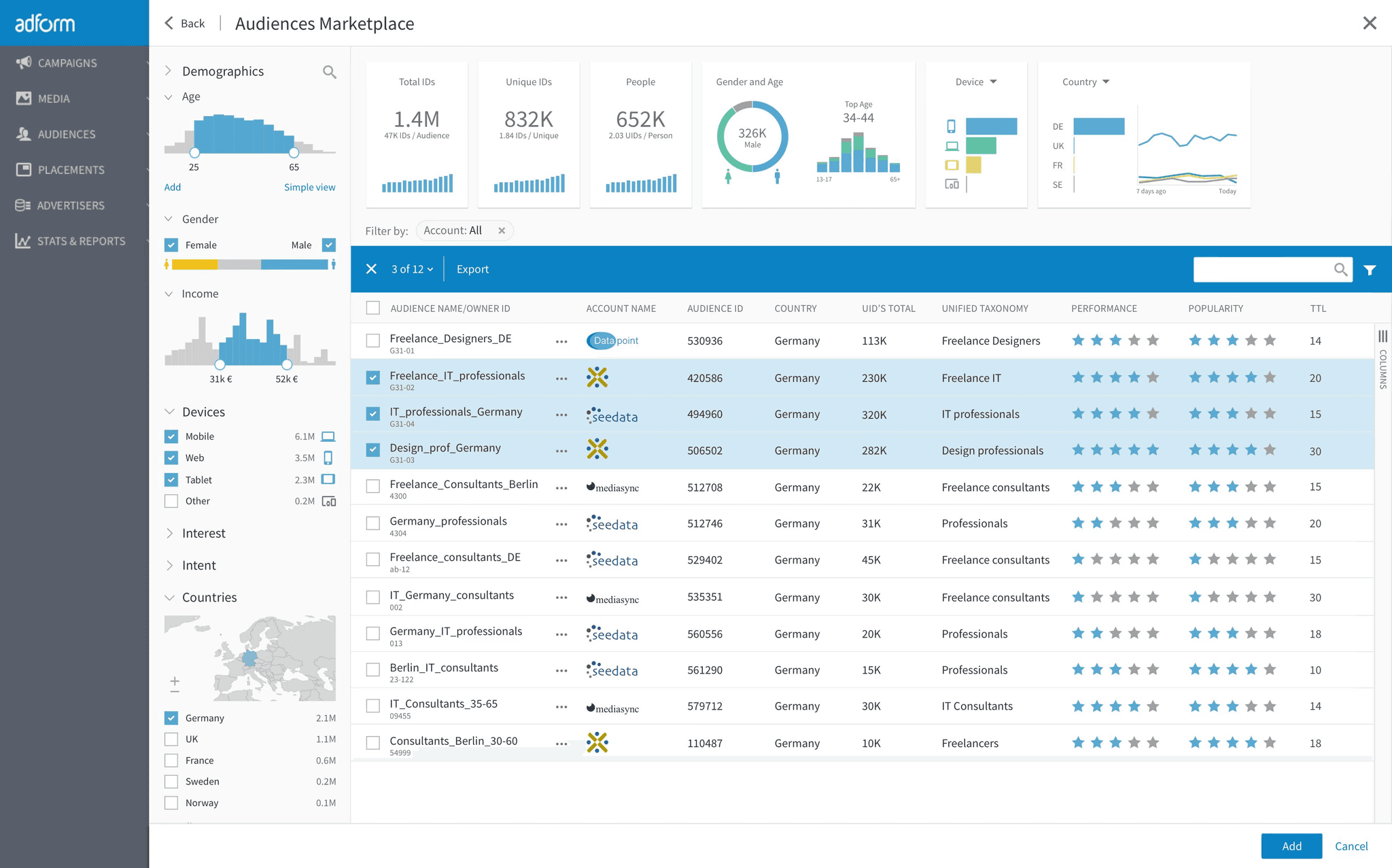
The differentiator is proof. In the Maxwin iGaming case study, AdGeeks ran Adform display across Germany and the UK as separate markets. The campaign used relevant sports, entertainment, gaming and news contexts, retargeting and adult audience controls. Optimization followed registrations and first-time deposits rather than cheap traffic.
The published results were a 43.74% website-to-registration conversion rate, a 42.50% registration-to-first-time-deposit conversion rate and a $51.26 cost per first-time deposit. Those figures describe one campaign, not a guaranteed benchmark. They are still useful evidence that the operating model reached the commercial event an iGaming buyer cares about.
Best for: licensed operators that need managed programmatic access, European campaign operations, Adform experience and reporting tied to registration and FTD.
Ask in the pitch: Which DSP, publishers and formats are approved for our exact licence, product and target market today?
2. TBD.Media - best for specialist iGaming display and video
TBD.Media positions itself as an iGaming programmatic display and video specialist. Its public programmatic service page describes an in-house DSP, sports and entertainment inventory, web, mobile, in-app and video placements, plus age-gating and geo-fencing for regulated markets.
The service is organized around the player lifecycle. Public use cases include awareness, acquisition, retargeting, retention and reactivation, with FTD, GGR and CPA named as possible campaign outcomes. That makes the offer relevant to operators that want a specialist team rather than a general programmatic desk learning the category during launch.
An in-house buying route can simplify activation, but it increases the need for transparency. Ask which exchanges and publishers sit behind the DSP, whether the operator receives placement-level reporting, how media and technology fees are separated and whether log-level data is available.
Best for: operators prioritizing specialist iGaming display, in-app and video execution with creative and compliance support.
Ask in the pitch: Can you show the exact supply path, domain or app list, viewability controls and total fee stack for our market?
3. Vertoz - best for programmatic plus alternative acquisition channels
Vertoz is useful when the acquisition plan needs more than standard open-web buying. Its iGaming offer combines programmatic advertising with mobile OEM and parked-domain traffic, subject to market and category eligibility.
The public page makes 2 important distinctions. First, it limits iGaming work to licensed operators and affiliates in lawful jurisdictions. Second, it says optimization should follow player value from registration to first deposit and beyond. That is a better starting point than traffic volume alone.
The broader source mix also creates a quality-control burden. Push, pop-under, parked-domain and OEM traffic do not behave like premium display or CTV. Require source-level reporting, separate performance baselines and a clear rule for excluding placements that produce registrations without depositing or retained players.
Best for: operators testing programmatic alongside mobile and alternative performance inventory in eligible markets.
Ask in the pitch: How will reporting separate each source, and which post-registration event will govern budget allocation?
4. Basher Agency - best for multichannel player acquisition
Basher Agency offers a broader acquisition mix. Its traffic-generation service lists paid social, search, native and programmatic display, with public references to Amazon DSP and The Trade Desk.
That breadth can suit operators that want one team coordinating casino or sportsbook acquisition across several paid channels. The agency also states that channel mix depends on licensed markets, brand stage and target CPA-to-LTV ratio, which is the right commercial frame for player acquisition.
The trade-off is depth verification. A multichannel agency may be strong overall while buying programmatic through a reseller or limiting reporting to aggregate dashboards. Ask whether the DSP seat is direct, which team operates it, what inventory restrictions apply and whether optimization receives event-level registration, FTD and value data.
Best for: operators seeking one acquisition partner across programmatic, social, search and native.
Ask in the pitch: Which DSP relationships are direct, and can the programmatic team optimize to FTD and value without blending the data with other channels?
5. MediaTroopers - best for North American regulatory coverage
MediaTroopers is a specialist digital acquisition business for regulated sports betting and casino markets. Its public site emphasizes digital media buying and states that the business holds supplier licences in 13 US states, ancillary licences in 6 and operates in 11 additional states plus Ontario where it says licensing is not required.
That footprint makes it relevant to a North American shortlist, where state or provincial eligibility can determine the entire media plan. The public page, however, does not clearly document a current DSP stack, programmatic formats or log-level reporting. Buyers should not assume those capabilities from the phrase “digital media buying.”
Best for: sportsbook and casino operators that prioritize regulated US and Ontario market knowledge.
Ask in the pitch: Which programmatic platforms and publishers can you operate directly in each licensed state, and what placement-level evidence will we receive?
Compliance changes the agency comparison
An iGaming agency cannot compensate for a missing licence, an unapproved product or a prohibited offer. Programmatic adds more gates because the operator, market, DSP, publisher, audience and creative must all be eligible at the same time.
In Great Britain, the UK Gambling Commission's advertising guidance points licensees to socially responsible marketing and the CAP and BCAP Codes. In Ontario, AGCO marketing rules restrict public bonus and inducement advertising and address underage, self-excluded and high-risk groups. Germany, Malta, the Netherlands, Sweden and US states apply different product, audience, offer and timing rules.
Use the iGaming programmatic compliance guide for the market-by-market operating detail. During agency selection, require a control matrix with these fields:
Control | What the agency should document | Evidence after launch |
|---|---|---|
Licence and product | Legal entity, licence, approved domain or app, product and market | Approval record tied to the campaign |
Age and exclusions | Local legal age, known-minor suppression, self-exclusion and opt-out handling | Audience settings and suppression refresh log |
Geography | Included jurisdiction, excluded borders and location method | Geo report and out-of-market exception review |
Creative and offers | Required disclosures, prohibited claims, bonus rules and approval owner | Approved creative register and version history |
Inventory | Accepted publishers, apps, formats and supply paths | Placement report, exclusions and quality changes |
Timing | Any daypart, event or product-specific restriction | Line-item schedule and delivery audit |
Local counsel and the relevant regulator should approve the final interpretation. The agency should translate that decision into settings and evidence, not replace legal advice.
Player acquisition should not stop at registration
A low registration CPA can hide low-quality traffic. The media team needs a conversion ladder that separates activity from value.
Qualified visit. The user lands in the licensed experience and passes basic eligibility checks.
Completed registration. The account is created and required verification steps are completed.
First-time deposit. The player makes the first qualifying deposit.
First wager or active play. The player reaches the next commercially meaningful event.
Retained value. The operator evaluates repeat activity, net revenue or another approved value measure over time.
The agency should state which event it can observe, which event controls bidding and how quickly each signal returns. It should also separate acquisition from reactivation and exclude people who must not receive marketing.
Attribution does not prove incrementality. A retargeting campaign can receive credit for a deposit that would have happened anyway. Ask the agency how it would design an eligible holdout, geography test, audience split or other counterfactual once tracking and volume are stable. The programmatic incrementality guide explains the difference between attributed conversions and causal lift.
12 questions to ask every iGaming programmatic agency
Which licences, products and markets have you operated in during the last 12 months?
Which DSP seats are direct, and which buying routes use a reseller or in-house platform?
Who approves the operator, product, creative and inventory before launch?
How are legal age, self-exclusion, opt-out and high-risk audience rules applied and refreshed?
Can you show the exact domain, app and supply-path reporting we will receive?
How will you prevent cross-border delivery and audit location quality?
Which events can you optimize to: registration, verification, FTD, first wager or retained value?
How will acquisition and reactivation audiences remain separate?
What is the complete fee waterfall for media, platform, data, verification, creative and management?
Who owns the account, tracking, audiences, history and data exports if the relationship ends?
What result would make you stop a source even if its registration CPA looks efficient?
How will you test incremental player acquisition after baseline tracking is stable?
Send the same questions to every candidate. Require written answers and score the evidence. A confident sales call is not a compliance system.
How to choose the right agency by brief
If the brief is... | Start with... | Why |
|---|---|---|
European programmatic with Adform and FTD evidence | AdGeeks | Published Germany and UK Adform case tied to registration and deposit outcomes |
Specialist iGaming display and video | TBD.Media | Public programmatic offer built around the iGaming player lifecycle |
Programmatic plus OEM or alternative traffic | Vertoz | Multiple source types with stated optimization toward player value |
One partner across search, social, native and programmatic | Basher Agency | Broad acquisition mix for casino and sportsbook operators |
Regulated US and Ontario media buying | MediaTroopers | Publicly stated licensing footprint and North American focus |
Do not award the work from the table alone. Use a paid or controlled pilot with one market, one product, a limited source set and agreed stop rules. Validate compliance evidence and event quality before adding markets or budget.
Frequently asked questions
What is an iGaming programmatic agency?
An iGaming programmatic agency plans and buys automated display, video, native, audio, in-app or CTV media for licensed gambling operators. It should manage market approvals, adult audience controls, inventory quality, conversion tracking and optimization toward qualified player outcomes.
Which agency is best for iGaming programmatic advertising?
There is no universal winner. AdGeeks is a strong fit for managed enterprise DSP access, European markets and Adform proof tied to first-time deposits. Other partners may fit better when the brief prioritizes an in-house DSP, alternative traffic, broad multichannel acquisition or North American licensing.
Which DSP is best for gambling advertising?
The best DSP is the one approved for the operator, product, market, audience and inventory required. Adform can be a strong European route. DV360 and other DSPs depend on current gambling certification, country rules, publisher acceptance and account eligibility.
Can programmatic campaigns optimize to first-time deposit?
Yes, when the operator can pass a reliable and permitted FTD event back to the buying and reporting workflow. The team should validate event definitions, consent, deduplication and latency before using FTD as an optimization signal.
How should iGaming agency performance be measured?
Track delivery and quality first, then qualified visits, registrations, verification, FTD, first wager and retained value where permitted. Report cost and conversion rate between stages. Do not use click-through rate or registration CPA as the only success measure.
What compliance evidence should an agency provide?
Request the approval record, licence and product map, geo settings, age and exclusion logic, creative register, publisher or app report, scheduling rules and incident process. Keep evidence for every market.
Should an iGaming operator use one agency across every market?
Only if the partner can prove local eligibility, inventory and operating knowledge in each jurisdiction. A shared agency can simplify data and reporting, but market controls, creative, budgets and benchmarks should remain separate.
How long should an iGaming programmatic pilot run?
A controlled pilot often needs 6-12 weeks, depending on approval time, conversion volume, event latency and seasonality. Define minimum data thresholds and stop rules before launch rather than extending a weak test because the DSP can still spend.
Choose the partner that can prove control
For iGaming, agency selection is an operating-risk decision before it is a media-rate decision. The right partner knows where the operator may advertise, which supply is actually available and how to prove that delivery stayed inside the rules.
Then performance can move down the funnel. Registrations become verified players. Verified players become first-time depositors. Media decisions follow player value rather than cheap traffic.