
Last verified: September 18, 2026
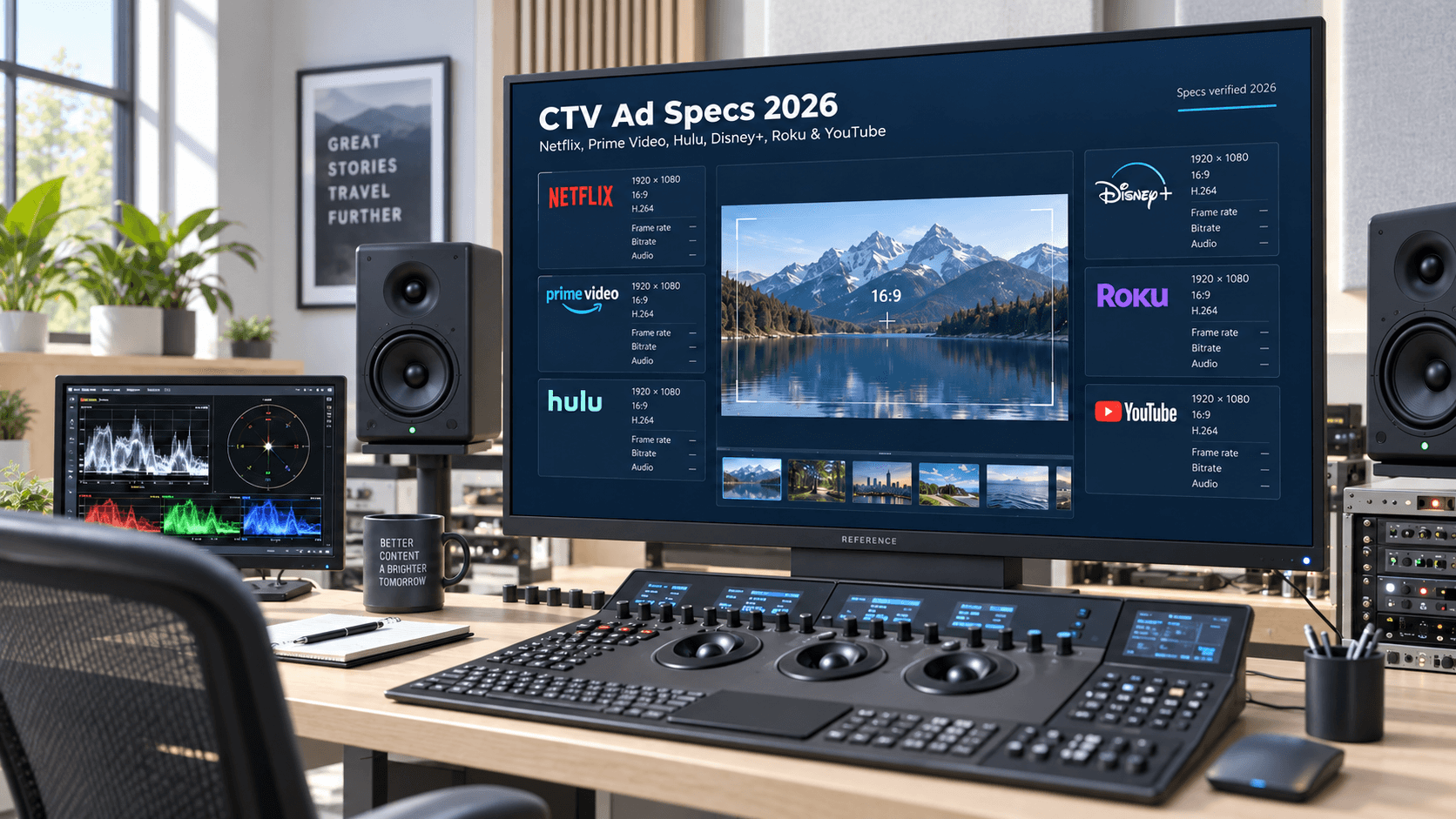
Connected TV creative delivery is not a one-file-and-forget process. Netflix, Prime Video, Hulu, Disney+, Roku and YouTube all accept high-definition 16:9 video, but they do not apply identical rules to duration, bitrate, file size, audio or third-party serving.
A file can look correct in an editing suite and still fail technical review because it uses a variable frame rate, contains more than one audio track, has the wrong loudness, places a QR code under a platform overlay or uses a duration that is unavailable in the selected market.
This guide compares the current public requirements and gives production teams a practical master specification for cross-platform CTV campaigns.
Important: Platform documentation changes. Always validate the final asset against the campaign’s insertion order, DSP creative screen and publisher trafficking sheet before launch.
Quick answer: For the widest 2026 CTV compatibility, start with a 1920×1080, 16:9, progressive MP4 using H.264 High Profile, a constant native frame rate of 23.98, 25 or 29.97 fps, at least 15 Mbps video bitrate, and two-channel AAC audio at 48 kHz. Produce 15- and 30-second versions, keep critical text and logos away from the outer edges and bottom-right corner, and retain a higher-quality ProRes master. This handoff works well across Netflix, Prime Video, Hulu, Disney+, Roku and YouTube, but it does not replace the final trafficking sheet: accepted durations, file-size limits, safe zones and tag rules still vary by platform, market and buying route.
CTV Ad Specs Comparison Table
Platform | Common / supported durations | Resolution and aspect ratio | File and codec | Frame rate | Video bitrate | Audio | File size |
|---|---|---|---|---|---|---|---|
Netflix | Pre-roll: 10, 15, 20, 30 sec. Mid-roll: 10, 15, 20, 30, 45, 60, 75 sec. Live: 15 or 30 sec unless approved otherwise | 1920×1080 preferred; 1280×720 accepted; 16:9; progressive | MP4/H.264 accepted; MOV/Apple ProRes preferred, although MOV is not accepted when delivered through Amazon DSP | 23.976, 24, 25, 29.97 or 30 fps; constant | H.264: over 12 Mbps at 1080p; ProRes: over 80 Mbps at 1080p | PCM preferred or AAC-LC; stereo; 48 kHz; AAC at least 192 kbps; -24 LKFS ±2; peaks no higher than -2 dB | 1 GB or less recommended; DSP limits may be lower |
Prime Video | Market-specific. US/CA: 15, 30, 45, 60 sec. UK/DE: 10, 15, 20, 30, 40, 60 sec. JP: 15 or 30 sec | Minimum 1920×1080; 16:9 | H.264, MPEG-2 or MPEG-4; MP4 required for site serving | 23.976 recommended; 24, 25 and 29.97 accepted; constant | 15 Mbps minimum for Prime Video; 50 Mbps recommended for Prime Video campaigns | AAC; at least two channels; minimum 192 kbps; 44.1 or 48 kHz | 500 MB |
Hulu | The booked placement determines the final spot length; Disney Campaign Manager accepts 5–90 sec video | 1920×1080 preferred; 1280×720 accepted; 16:9; progressive | MOV, MP4 or M4V; Apple ProRes 422 HQ or H.264 | 23.98, 24, 25, 29.97 or 30 fps; constant | 10–40 Mbps CBR for standard delivery; programmatic guidance prefers 15–60 Mbps CBR | PCM or AAC; stereo; at least 128 kbps; 44.1 or 48 kHz | 250 MB when Hulu-served; 1.9 GB for partner-, VAST- or programmatic-served assets |
Disney+ | 15, 30, 45, 60, 75 or 90 sec in Disney’s current Disney+ specification; confirm the booked format | 1920×1080 preferred; 1280×720 accepted; 16:9; progressive | MOV or MP4; Apple ProRes or H.264 High Profile | 23.98, 24, 25, 29.97 or 30 fps; constant/native | 10–40 Mbps CBR | PCM or AAC; stereo; at least 128 kbps; 44.1 or 48 kHz | 250 MB Disney-hosted; 1.9 GB VAST |
Roku Ads Manager | 6–92 sec | 16:9. Use a 1920×1080 master for cross-platform delivery | MOV or MP4; AVC/H.264 or ProRes 422 HQ | 23.98, 25 or 29.97 fps | Minimum 6 Mbps | PCM preferred or AAC; stereo; 48 kHz; minimum 96 kbps | 1 GB |
YouTube / YouTube on TV | Bumper: 5–6 sec. Non-skippable: 15–60 sec depending on campaign subtype. Skippable: no hard maximum, but under 3 minutes is recommended | 16:9 is standard for TV; 1920×1080 recommended for HD delivery | Video must be hosted on YouTube; MP4 with H.264 High Profile recommended | Upload in the native frame rate; common rates include 24, 25, 30, 48, 50 and 60 fps | 1080p SDR: 8 Mbps at 24–30 fps or 12 Mbps at 48–60 fps | AAC-LC, Opus or Eclipsa Audio; 48 kHz; 384 kbps recommended for stereo | Governed by YouTube upload limits rather than a CTV-specific trafficking cap |
The Safest Cross-Platform CTV Master File
If one production master must cover all six platforms, use this baseline:
Attribute | Recommended cross-platform master |
|---|---|
Canvas | 1920×1080 |
Aspect ratio | 16:9 |
Scan | Progressive |
Container | MP4 |
Video codec | H.264 High Profile |
Frame rate | Native and constant; choose 23.98, 25 or 29.97 fps |
Video bitrate | 15–20 Mbps for the trafficking file |
Audio codec | AAC-LC |
Audio channels | Two-channel stereo |
Audio sample rate | 48 kHz |
Audio bitrate | 192–384 kbps |
Loudness target | -24 LKFS ±2, with peaks at or below -2 dB |
Core lengths | 15 and 30 seconds |
Safe composition | Keep essential content inside the central 80–90%; reserve the top-right and bottom-right for platform UI or QR overlays |
Archive master | Retain a ProRes 422 HQ version for re-encoding |
Why this works: 1920×1080 H.264 MP4 is accepted or readily transcoded across the major platforms, while 23.98, 25 and 29.97 fps fit the narrowest shared frame-rate set. A 15 Mbps file clears Prime Video’s minimum and stays comfortably above Roku’s minimum. Netflix’s loudness rule is also a sensible broadcast-quality target for the shared master.
The major exception is Netflix delivered through a route that prefers or requires a higher-bitrate file, and any publisher or DSP that imposes its own lower file-size cap. Keep the ProRes master so the trafficking team can create platform-specific derivatives without re-exporting from a compressed file.
Netflix Ad Specs in 2026
Netflix publishes separate rules for standard video, live inventory and pause ads. Standard video can run across desktop, mobile and CTV, but the delivery route changes what files and tags are accepted.
Netflix video and file requirements
Preferred resolution: 1920×1080; 1280×720 is accepted.
Display aspect ratio: 16:9.
Scan: progressive.
Preferred codec: Apple ProRes in MOV.
Accepted codec: H.264 in MP4.
Frame rates: 23.976, 24, 25, 29.97 or 30 fps, in constant frame-rate mode.
H.264 bitrate: above 12 Mbps for 1080p or above 8 Mbps for 720p.
ProRes bitrate: above 80 Mbps for 1080p or above 42 Mbps for 720p.
Recommended file weight: 1 GB or less.
Track rule: exactly one video track and one audio track, with durations matching within 500 ms.
Netflix notes that MOV is not accepted when the creative is delivered through Amazon DSP. That is a useful example of why publisher approval and DSP upload approval are not the same thing.
Netflix duration rules
Pre-roll: 10, 15, 20 or 30 seconds.
Mid-roll: 10, 15, 20, 30, 45, 60 or 75 seconds.
Live: 15 or 30 seconds; ask the account team about additional lengths.
Netflix audio and safe-zone rules
Netflix prefers PCM and accepts AAC-LC. Use two-channel stereo at 48 kHz. AAC-LC should be at least 192 kbps. Average program loudness should be -24 LKFS ±2 and sample peaks should not exceed -2 dB.
The platform can place an ad timer in the top-right and, in some formats, a QR code in the bottom-right. Keep critical text, logos, product shots and legal copy toward the center or center-left. Netflix recommends allowing at least 72 hours for creative pre-registration; restricted-category approval can take up to five days.
For a broader view of activation and buying, see Netflix Advertising Through DV360 in 2026.
Prime Video Ad Specs in 2026
Amazon’s Streaming TV specification covers Prime Video as well as other Amazon and third-party streaming supply. Prime Video has the strictest bitrate requirement in that group.
Prime Video technical requirements
Minimum frame size: 1920×1080.
Aspect ratio: 16:9.
Maximum file size: 500 MB.
Supported video: H.264, MPEG-2 or MPEG-4.
Site serving: MP4 is required.
Frame rates: 23.976 fps recommended; 24, 25 and 29.97 accepted.
Frame-rate mode: constant.
Prime Video bitrate: at least 15 Mbps; Amazon recommends 50 Mbps for Prime Video campaigns.
Audio: AAC, minimum two channels, at least 192 kbps, 44.1 or 48 kHz.
Prime Video duration varies by market
Do not place one universal duration list in a global production brief. Amazon’s current table differs by country. For example, the US and Canada accept 15-, 30-, 45- and 60-second Prime Video ads, while the UK and Germany list 10, 15, 20, 30, 40 and 60 seconds. Japan lists 15 and 30 seconds.
Non-interactive Streaming TV ads run in a non-clickable environment, so the video should not contain a button-style “Learn more” or “Buy now” CTA. Interactive overlays have separate safe-zone and policy rules.
Read the Prime Video Advertising Guide for campaign planning, inventory and buying considerations.
Hulu Ad Specs in 2026
Disney’s current Video Commercial page applies to commercial breaks across Hulu and Disney+. Hulu accepts site-served and programmatic delivery, but the file-size and bitrate guidance changes with the route.
Hulu video requirements
Preferred resolution: 1920×1080; 1280×720 accepted.
Required aspect ratio: 16:9.
Formats: MOV, MP4 or M4V.
Codecs: Apple ProRes 422 HQ or H.264.
Frame rates: 23.98, 24, 25, 29.97 or 30 fps, based on the native frame rate.
Constant frame rate and progressive scan are required.
Standard bitrate: 10–40 Mbps CBR.
Programmatic bitrate: 15–60 Mbps CBR preferred; 20–60 Mbps VBR accepted.
Audio: PCM or AAC, two channels, at least 128 kbps, 44.1 or 48 kHz.
File size: up to 250 MB for Hulu-served files or 1.9 GB for partner-, VAST- or programmatic-served files.
Disney Campaign Manager accepts video between 5 and 90 seconds, but the specific Hulu placement or deal determines which spot lengths can actually serve. Treat the media plan or IO as the controlling duration requirement.
VAST 2.0 and 3.0 are accepted from approved vendors. VPAID and VAST wrappers are not accepted. For programmatic deals, the creative must be trafficked in the DSP and remain compliant after transcode.
Disney+ Ad Specs in 2026
Disney+ and Hulu now share much of Disney Advertising’s Video Commercial workflow, but Disney also publishes a dedicated Disney+ specification updated March 5, 2026.
Disney+ video requirements
Durations: 15, 30, 45, 60, 75 or 90 seconds.
Preferred resolution: 1920×1080; 1280×720 accepted.
Aspect ratio: 16:9.
Formats: MOV or MP4.
Codecs: Apple ProRes or H.264 High Profile.
Frame rates: 23.98, 24, 25, 29.97 or 30 fps in the native frame rate.
Frame-rate mode: constant.
Scan: progressive.
Bitrate: 10–40 Mbps CBR.
Audio: PCM or AAC, two-channel stereo, minimum 128 kbps, 44.1 or 48 kHz.
File size: 250 MB for Disney-hosted assets or 1.9 GB for VAST.
Disney+ overlays an “Ad” label and countdown timer. On a 1920×1080 file, avoid placing important content in the top-right 220×135-pixel area. Disney’s dedicated specification lists up to four business days for production, while the combined Video Commercial page lists up to five business days from receipt of final assets. Plan around the longer window.
Roku Ad Specs in 2026
Roku Ads Manager uses a broad duration range but a comparatively narrow frame-rate list.
Roku technical requirements
Duration: 6–92 seconds.
Aspect ratio: 16:9.
Formats: MOV or MP4.
Video codec: AVC/H.264 or ProRes 422 HQ.
Frame rates: 23.98, 25 or 29.97 fps.
Video bitrate: minimum 6 Mbps.
Audio: PCM preferred or AAC accepted.
Audio channels: two-channel stereo.
Audio sample rate: 48 kHz.
Audio bitrate: minimum 96 kbps.
File size: maximum 1 GB.
Roku’s public technical overview does not state a pixel dimension in the same table. For a multi-platform campaign, use 1920×1080 rather than creating a Roku-only lower-resolution master.
Roku performs an automated technical review and then a manual content review. The manual review usually takes two to three business days, so upload before the planned launch date.
YouTube CTV Ad Specs in 2026
YouTube is different from the other publishers in this comparison because the ad video must be hosted on YouTube. The platform transcodes the upload, and Google Ads controls the campaign format.
Recommended YouTube upload settings
Container: MP4.
Video codec: H.264 High Profile.
Scan: progressive.
Chroma subsampling: 4:2:0.
Bitrate mode: variable bitrate.
Standard TV aspect ratio: 16:9.
Recommended HD resolution: 1920×1080.
Frame rate: upload at the same frame rate as the source; common accepted rates include 24, 25, 30, 48, 50 and 60 fps.
Recommended SDR bitrate at 1080p: 8 Mbps for 24–30 fps or 12 Mbps for 48–60 fps.
Audio: AAC-LC, Opus or Eclipsa Audio; 48 kHz; 384 kbps recommended for stereo.
YouTube ad duration depends on format
Bumper: between five and six seconds, non-skippable.
Non-skippable in-stream: 15–60 seconds depending on the campaign subtype.
Skippable in-stream: no hard maximum, although Google recommends keeping it under three minutes.
Masthead: no hard maximum; Google recommends more than 10 seconds. On TV screens, the featured video autoplays without sound where supported and cannot include a clickable CTA.
Some in-stream ads can appear on YouTube TV when eligible, but “YouTube CTV” is not a separate universal upload specification. The campaign type, inventory eligibility and device targeting determine whether the ad reaches TV screens.
Why CTV Creatives Get Rejected
1. Variable or converted frame rates
CTV platforms prefer native, constant frame rates. A 23.98 fps source converted to 30 fps can introduce duplicated frames and fail automated checks.
2. Multiple audio or video tracks
Netflix and Disney explicitly require a single video track and a single audio track. Remove alternate-language tracks before trafficking separate localized files.
3. Incorrect aspect ratio or baked-in bars
Deliver a true 16:9 file. Letterboxing and pillarboxing are discouraged or restricted and may conflict with interactive overlays.
4. Text or QR codes under platform UI
Timers, ad labels and interactive overlays often occupy the top-right or bottom-right. Keep essential elements inside a conservative safe zone.
5. Click-style CTAs in non-clickable TV inventory
A button that says “Learn more” can be misleading when the TV placement is not clickable. Use a URL, brand mnemonic, QR code only where approved, or a platform-supported interactive overlay.
6. Audio outside broadcast tolerance
Inconsistent loudness is especially noticeable inside premium streaming content. Use the strict Netflix target—-24 LKFS ±2 with peaks at or below -2 dB—as a cross-platform production standard unless the buying team provides a different requirement.
7. Uploading too close to launch
Technical and policy review can take several business days. Build at least five business days into the launch plan, and more for restricted categories, new vendors or interactive formats.
A Practical CTV Creative QA Checklist
Before delivery, confirm:
The media plan lists each platform, market, buying route and booked duration.
The video is 1920×1080, 16:9 and progressive.
The frame rate is native and constant.
The file contains exactly one video track and one audio track.
H.264 bitrate meets the strictest destination requirement.
Audio is stereo, 48 kHz and within the required loudness range.
The opening frame does not contain a slate or countdown.
Logos, legal copy and products stay inside the safe zone.
QR codes and interactive elements are approved for the selected format.
The file name, landing destination and tracking tags match the trafficking sheet.
VAST version, wrappers and verification tags are permitted by the publisher.
The uploaded derivative is checked after DSP or platform transcode.
Creative approval is complete before the campaign start date.
One Master or Separate Platform Files?
Use one shared production master, but create separate trafficking files when:
Prime Video needs a higher bitrate than another platform’s upload cap allows.
Netflix is delivered through a DSP that does not accept MOV.
Different markets require different durations.
A platform adds a QR code, interactive overlay or unique safe zone.
Localized audio or legal copy changes by country.
YouTube needs a separately hosted asset and campaign-specific duration.
The efficient workflow is master once, derive carefully and document every version - not export one compressed file and repeatedly transcode it.
Explore AdGeeks Connected TV solutions
AdGeeks helps advertisers plan, adapt and activate Connected TV campaigns across premium streaming inventory and programmatic platforms. We can validate creative before launch, map the correct asset to each market and buying route, and coordinate measurement without treating every CTV publisher as identical.
Frequently Asked Questions
What is the best file format for CTV ads in 2026?
For the broadest compatibility, use a 1920×1080 MP4 with H.264 High Profile, progressive scan and two-channel AAC audio. Keep a ProRes 422 HQ master for destinations that prefer mezzanine-quality files or require a different derivative.
Are all CTV ads 15 or 30 seconds?
No. Fifteen and 30 seconds are the safest common lengths, but Netflix supports additional pre-roll and mid-roll durations, Prime Video varies by market, Disney+ lists 15–90 seconds, Roku accepts 6–92 seconds and YouTube duration depends on ad format.
What resolution should a CTV ad be?
Use 1920×1080 at 16:9. Netflix and Disney accept 1280×720 in some workflows, but Prime Video requires at least 1920×1080 and premium TV screens benefit from a full-HD master.
Should a CTV ad include a clickable CTA?
Usually not as a button inside a standard non-clickable TV spot. Amazon explicitly discourages click-style CTAs in non-interactive Streaming TV ads. Use a URL, approved QR code or publisher-supported interactive feature instead.
Can the same file run on Netflix and Prime Video?
Often yes if it is a 1920×1080 H.264 MP4 at an accepted duration and bitrate. However, Netflix and Prime Video have different duration tables, bitrate guidance, audio rules and safe zones. The buying route can also change the accepted container or file-size limit.
How early should CTV creative be submitted?
Plan for at least five business days. Netflix requests at least 72 hours for pre-registration, Roku’s manual review usually takes two to three business days, and Disney lists up to four or five business days depending on the workflow. Restricted categories can take longer.
Do CTV platforms accept VAST tags?
Many do, but not under identical rules. Netflix supports specific VAST and ad-server workflows; Disney accepts VAST 2.0 and 3.0 from approved vendors but not VPAID or wrappers; Amazon accepts inline VAST 2.0 or 3.0 from certified vendors and rejects VPAID and wrapper tags. Confirm the deal and vendor before trafficking.
Official Sources
Specifications were verified against the linked platform documentation on September 18, 2026. Final campaign requirements may vary by market, deal type, inventory source, DSP and direct-sales agreement.