DV360 and The Trade Desk can both run sophisticated Connected TV campaigns, but they do not create the same buying environment. DV360 connects CTV with YouTube and the Google Marketing Platform stack. The Trade Desk approaches CTV through the open internet, identity tools, data partners and an omnichannel workflow.
The right choice depends on the inventory you can actually buy, the audience signal you can legally activate, the measurement your team trusts and the account access you can keep. A platform logo is not a media plan. Advertisers should compare the exact seat, market, publisher route, data rights and service model offered to them.
Quick answer: Choose DV360 first when YouTube CTV, Google-linked measurement and enterprise governance are central. Evaluate The Trade Desk first when open-internet CTV, UID2 or retail-data activation and cross-publisher omnichannel control matter more. Neither platform guarantees every publisher, market or measurement option. Verify the exact seat, deals, fees, data rights and admin access before signing.
DV360 vs The Trade Desk for CTV at a glance
Defining inventory advantage
DV360: Native YouTube and partners buying, plus eligible open-internet CTV supply and deals.
The Trade Desk: Open-internet CTV supply, publisher relationships and eligible premium streaming deals.
Takeaway: Start with a must-have publisher and deal map, not a platform-wide inventory claim.
Audience data
DV360: First-party lists, eligible third-party data, Google audiences and Google-linked workflows, with inventory and market limitations.
The Trade Desk: First-party data, UID2 or EUID, cross-device identity, eligible third-party and retail-data options.
Takeaway: Choose the signal that can activate on the intended CTV supply in the intended market.
Workflow
DV360: Dedicated CTV insertion orders and line items, plus YouTube and broader Google Marketing Platform connections.
The Trade Desk: Kokai workflow with campaign, ad-group, forecasting, reporting and omnichannel optimization tools.
Takeaway: Test the exact workflow with the people who will build, QA and optimize campaigns.
Measurement
DV360: DV360 reporting, Floodlight, eligible cross-device conversions, CTV reach tools and CM360 connections.
The Trade Desk: First-party conversion data plus a marketplace of eligible independent measurement providers and data partners.
Takeaway: Name the source of truth before selecting the platform.
Access and governance
DV360: Partner and advertiser hierarchy with documented user roles. Access may be direct or partner-provided.
The Trade Desk: Enterprise access and support depend on the contract, seat and service provider.
Takeaway: Contractual control matters as much as technical capability.
Best starting point
DV360: YouTube-heavy, Google-centered or tightly governed enterprise media operations.
The Trade Desk: Open-internet, identity-led, retail-data or omnichannel media strategies.
Takeaway: Many advertisers can justify both, but each platform needs a distinct job.
Bottom line: DV360 is not simply the Google option, and The Trade Desk is not simply the open-internet option. Both can buy CTV and use first-party data. The useful differences appear at the level of specific inventory, identity, workflow, measurement and access terms.
Which platform has better CTV inventory?
Neither platform has a universal inventory win. CTV access changes by country, publisher, exchange, deal, seat and commercial agreement. The question is not which DSP shows more publisher logos. It is whether the advertiser can buy the exact apps, services, content packages and live events required by the plan.
Where DV360 is differentiated
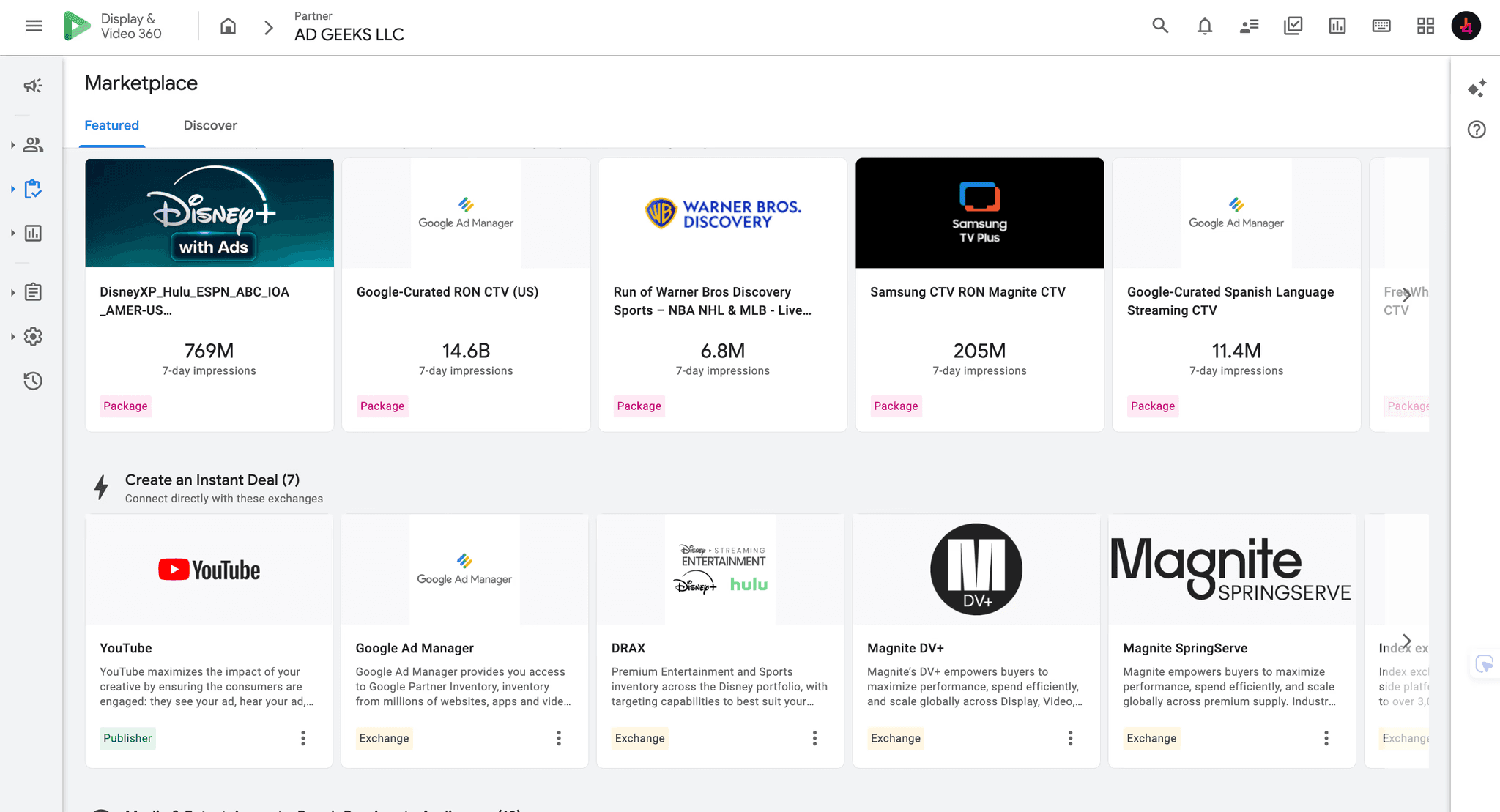
Google documents dedicated Connected TV insertion orders and line items in DV360. These workflows can include non-YouTube premium TV inventory and YouTube and partners on Connected TV. DV360 can also buy CTV through supported real-time bidding structures and publisher deals.
YouTube is the clearest platform-level differentiator. If the media plan treats YouTube on television screens as a core reach layer, DV360 provides a native enterprise buying route alongside other Google and open-internet activity. The advantage is strongest when the team also needs shared governance, planning and measurement conventions across YouTube, display, video and CTV.
Where The Trade Desk is differentiated
The Trade Desk positions CTV as part of an open-internet, omnichannel buying environment. Its public materials emphasize premium CTV publishers, cross-publisher reach, frequency management and data-driven activation. It also publishes resources for deal-based inventory, live content and content signals.
This can be valuable when the plan is built around premium streaming supply outside YouTube, or when CTV must work with display, audio, mobile and other open-internet channels in one audience strategy. Still, a public partnership announcement does not prove that every advertiser seat can buy every title, event or market.
Build a route-level inventory map
For every required publisher, ask both providers to complete the same fields:
publisher, app, channel, content package and country;
open auction, curated marketplace, private marketplace, preferred deal or programmatic guaranteed route;
direct seller, reseller path and supply fees;
floor price, forecasted scale and expected frequency;
app, channel, show or content reporting available after delivery;
audience, brand-safety and measurement compatibility;
creative specifications, approval lead time and replacement rules.
Use the premium CTV inventory map to structure the review, then confirm every route against the live seat. If the buying method is still undecided, compare direct IO, PMP and open auction for CTV before selecting the DSP.
How do audience data and identity differ?
CTV has no single universal identifier. Household graphs, device identifiers, signed-in environments, publisher data and first-party customer records can all contribute to activation and measurement. Availability changes by market, consent framework, publisher and inventory route.
DV360 audience options
Google documents first-party and third-party lists, selected Google audiences and demographic targeting for CTV, subject to regional and inventory-specific rules. Customer Match can support eligible first-party activation. Google also notes that some non-YouTube CTV workflows have limitations, including restrictions on combined audiences containing first-party lists.
DV360 is a practical fit when the advertiser already uses Google-linked audience, tagging and measurement systems. That convenience still requires a technical check. A list visible in the platform may not be eligible for the selected inventory, region or line-item type.
The Trade Desk audience options
The Trade Desk describes first-party activation through its identity environment, including UID2, EUID, a cross-device graph and Galileo. Its public platform materials also emphasize third-party data, retail-data partnerships and privacy-conscious omnichannel addressability.
This approach can suit advertisers that want to connect CRM data, retail signals and open-internet media without centering the plan on Google-owned inventory. The same caution applies: ask which identifiers, providers and match methods are enabled for the advertiser, country and CTV supply in question.
Compare usable data, not data logos
Consent and source
Ask: What permission allows this data to be used for CTV activation and measurement?
Why it matters: A technically available list may not be legally or contractually usable.
Match and scale
Ask: What is the eligible matched audience after geography, inventory and privacy rules?
Why it matters: Uploaded records are not the same as addressable CTV households.
Suppression
Ask: Can customers, converters or exposed households be excluded reliably?
Why it matters: Suppression affects waste, incrementality and frequency.
Portability
Ask: Who controls the source data, mapped segments and export rights if the partner changes?
Why it matters: Partner-owned configurations can create switching risk.
Measurement
Ask: Can the same identity method connect exposure to the agreed business outcome?
Why it matters: Targeting precision is not useful if outcomes cannot be evaluated.
How do the campaign workflows compare?
DV360: structured CTV and Google-linked operations
DV360 offers a dedicated CTV insertion-order workflow with settings designed for television buying. Google documents Connected TV line items, YouTube and partners on CTV line items, CTV forecasting and standard reporting dimensions. The wider partner, advertiser, campaign, insertion-order and line-item hierarchy supports complex governance across markets and teams.
This depth helps organizations that need detailed roles, naming standards, approval processes and links to Campaign Manager 360 or Floodlight. It also creates operational complexity. Teams should test bulk operations, QA steps, deal management, forecasting and reporting before assuming the workflow will be efficient.
The Trade Desk: Kokai and omnichannel decisioning
The Trade Desk's current Kokai materials describe campaign and ad-group views, real-time validation, forecasting tiles, reporting views and AI-supported omnichannel optimization. The platform is designed to connect audiences and optimization across CTV and other open-internet channels.
That can reduce channel silos when the same team manages CTV, display, audio and online video. Public platform claims should still be validated in a live demo. Ask the provider to build a representative campaign, apply data, attach a deal, configure frequency, run QA and produce the exact report your team needs.
Run the same workflow test in both platforms
A useful evaluation uses a real brief and a timed task. Have each provider demonstrate:
forecasting reach and frequency for the same market and audience;
finding and attaching the same eligible publisher deal;
applying first-party data, exclusions and frequency controls;
uploading and approving the same CTV creative;
reviewing settings before launch and documenting approval;
diagnosing underdelivery without exporting a custom spreadsheet;
producing a publisher, app, reach, frequency and outcome report;
exporting the campaign record and change history needed for governance.
Which platform is stronger for measurement?
Platform reporting and business measurement are different jobs. Both DSPs can report delivery, but neither should be treated as an automatic proof of incrementality. Define the source of truth, attribution window, identity method, control design and reporting owner before launch.
DV360 measurement strengths and limits
Google documents CTV reporting by device type, app identifiers and eligible channel or show signals. Publisher data can be incomplete because some sellers withhold title-level information. DV360 can also connect CTV exposure with eligible Floodlight cross-device conversions and offers reach planning and cross-media reporting tools.
This is useful for teams already operating within Google Marketing Platform. Implementation quality remains decisive. Incorrect Floodlight settings, account links or attribution rules can make an integrated stack look more coherent than it actually is.
The Trade Desk measurement strengths and limits
The Trade Desk says advertisers can onboard first-party conversion data and use a marketplace of independent measurement partners for outcomes including brand lift, foot traffic and retail sales. This can give buyers flexibility to select a source of truth outside the DSP.
Independent providers still require eligibility, matching, minimum scale and separate commercial terms. Ask which studies are available in the required country, what data leaves each system, how exposed and control groups are formed and whether results can be exported.
What does partner access change?
Access is not a binary yes or no. The contract determines whether the advertiser receives a login, what role it has, which reports it can export, who controls billing and data, and what remains after the relationship ends.
DV360 access and governance
Google documents partner-level and advertiser-level user management with distinct roles. A provider can therefore grant meaningful platform access without necessarily granting every administrative right. Ask for the exact role, account hierarchy and assets covered by the contract.
If DV360 is provided through a reseller or agency, confirm advertiser ownership, user administration, reporting exports, Floodlight and CM360 control, deal portability and transition support. The DV360 data-ownership checklist covers the contract questions in detail.
The Trade Desk access and governance
The Trade Desk access model offered to an advertiser can vary by contract, seat, geography and service provider. Do not assume that a self-service label gives the advertiser full administrative control, or that a managed-service label prevents useful visibility. Ask the provider to show the account structure and permissions before signing.
Require these terms in writing
advertiser login and exact role from the first campaign day;
ownership and export rights for campaigns, reports, conversion settings and audiences;
access to publisher, app, deal and fee-level reporting;
who creates and controls deals, data integrations and measurement studies;
platform, data, measurement, management and creative fees shown separately;
service levels for trafficking, optimization, QA and incident response;
data retention, offboarding and transition-assistance terms;
a process for adding another agency or bringing trading in-house.
Decision rule: Compare the access you will receive, not the platform access your provider has. A capable DSP inside a restricted seat can be less useful than a well-governed account with clear export and transition rights.
How should fees and minimums be compared?
Public platform pages do not provide one globally comparable CTV rate card for these two DSPs. Commercial terms can vary by region, spend, seat, inventory, support and partner. Request both proposals against the same media plan.
Calculate total effective cost as:
Media + platform or access fee + data + ad serving + verification + measurement + management + creative
Then compare forecasted unique reach, frequency, publisher mix and measurable outcomes after all fees. A lower headline platform fee can lose its advantage if the required data, measurement or support is charged separately.
When should you choose DV360 for CTV?
Start with DV360 when several of these conditions are true:
YouTube on Connected TV is a non-negotiable part of the plan;
the organization already uses CM360, Floodlight or other Google Marketing Platform workflows;
enterprise roles, hierarchy and multi-market governance matter;
the required publishers and deals are confirmed in the available DV360 seat;
the team values one operational environment for YouTube and eligible open-internet CTV;
the contract grants the advertiser adequate data, reporting and transition rights.
Review the broader DV360 vs independent DSPs comparison if CTV is only one part of a larger platform decision.
When should you choose The Trade Desk for CTV?
Evaluate The Trade Desk first when several of these conditions are true:
open-internet CTV publishers and deal paths are the center of the plan;
UID2, EUID, cross-device identity or first-party onboarding is strategically important;
retail data or independent measurement partners are required;
CTV must be optimized alongside display, audio, mobile or online video;
the available seat provides the required supply, data and reporting in the target market;
the contract gives the advertiser appropriate visibility and exit rights.
For a deeper single-platform review, see the guide to The Trade Desk CTV inventory, targeting and measurement.
When does a dual-DSP plan make sense?
A dual-DSP plan can make sense when each platform has a distinct role. For example, DV360 may handle YouTube CTV while The Trade Desk handles specific open-internet publishers, retail data or identity-led activation. This is not automatically better. It adds duplicate reach, fees, trafficking, reporting and reconciliation work.
Use two DSPs only when the incremental value is clear and the operating plan covers:
exclusive or meaningfully different inventory and data;
budget allocation rules and overlap monitoring;
frequency strategy across platforms;
consistent creative, brand-safety and suitability standards;
a deduplicated reach and outcome measurement method;
one naming, taxonomy and reporting specification;
a decision rule for reducing or removing a platform.
Ad Geeks can map inventory, data, fees, workflow and account rights across DV360 and The Trade Desk, then recommend a platform-neutral CTV buying route.
A 12-point CTV DSP scorecard
Required inventory: Is every must-have publisher and market confirmed in the proposed seat?
Supply path: Is each route direct, curated, resold, private or guaranteed?
YouTube role: Is YouTube CTV central, complementary or outside the scope?
First-party data: Can the intended customer data activate at usable scale?
Identity: Does the identity method work across the selected publishers and countries?
Retail data: Are the required providers, segments and sales-measurement options available?
Frequency: Can the team control and evaluate exposure across publishers and channels?
Measurement: Can the platform support the agreed source of truth and study design?
Workflow: Can the team forecast, build, QA, optimize and report without hidden manual work?
Transparency: Are publisher, app, deal, data and fee details available at the required level?
Access: Does the advertiser have the roles, exports and administrative rights it needs?
Exit: Can campaigns, reports, data documentation and operational history be retained during a transition?
Score each item from 0 to 3: unavailable, unclear, available with conditions, or fully verified. Weight inventory, data, measurement and access more heavily than presentation quality in a sales demo. The best DSP is the one that passes the real campaign test with the fewest unresolved dependencies.
Frequently asked questions
Is DV360 better than The Trade Desk for CTV?
Not universally. DV360 has a clear advantage when YouTube CTV and Google-linked workflows are central. The Trade Desk may be a better fit for open-internet CTV, UID2 or EUID, retail data and independent measurement partnerships. Confirm inventory and account terms for the specific market.
Can both DSPs buy premium streaming inventory?
Yes, both can access eligible premium CTV supply through supported exchanges, marketplaces and deals. Access varies by publisher, market, seat and contract. A partnership announcement is not proof that a specific advertiser can activate the inventory.
Which DSP is better for YouTube on TV screens?
DV360 is the stronger starting point because Google provides native YouTube and partners on Connected TV line items. The Trade Desk is not a substitute for DV360's native YouTube buying route.
Which platform is better for first-party data?
It depends on the data, consent, identifier and inventory. DV360 supports eligible first-party workflows inside Google's advertising environment. The Trade Desk emphasizes first-party onboarding, UID2 or EUID and cross-device identity across the open internet. Compare usable matched scale, not upload capability.
Can one agency manage both DV360 and The Trade Desk?
Yes, if it has authorized access and a clear operating model. Require separate platform roles, fee disclosure, naming standards, overlap controls, deduplicated measurement and exit rights. Multi-DSP access without cross-platform governance can increase waste.
What should advertisers verify before signing a partner contract?
Verify the exact seat, publishers, markets, data providers, measurement options, all fees, service scope, user roles, export rights, data ownership and offboarding support. Ask the provider to demonstrate these items in the proposed account structure.