A practical guide to what a DV360 managed service should include, how managed, self-service and hybrid operating models differ, what drives cost, and what an advertiser should expect from campaign execution and reporting.
Last verified: September 10, 2026.
Display & Video 360 gives advertisers a programmatic buying environment for eligible display, video, Connected TV, audio, YouTube and publisher inventory.
But platform access is only one part of operating DV360 successfully.
Someone still needs to turn the business objective into campaign architecture, choose audiences and inventory, configure budgets and controls, complete launch QA, monitor delivery, diagnose problems, optimize performance and explain what the results mean.
That is the role of a DV360 managed service.
A strong managed service is not simply a login plus occasional campaign edits. It adds the people, processes and accountability required to operate the platform.
For platform access and campaign support, see AdGeeks’ Google DV360 solution.
DV360 managed service: the answer in one minute
Area | What a managed service should provide |
|---|---|
Platform access | DV360 infrastructure under the provider’s applicable account and commercial arrangement |
Strategy | Objectives, KPIs, audience plan, inventory plan, channel roles and measurement approach |
Setup | Campaign, insertion order, line item, targeting, creative, budget and control configuration |
Media buying | Budget allocation, bidding, inventory selection and eligible deal activation |
Optimization | Pacing, bid, audience, inventory and creative decisions tied to the campaign KPI |
Troubleshooting | Diagnosis of delivery, tracking, creative, deal, targeting and configuration problems |
Reporting | Performance data, interpretation, actions taken and next-step recommendations |
Best fit | Teams that need DV360 capability without building a complete in-house trading operation |
Alternatives | Self-service access or a hybrid split of advertiser and provider responsibilities |
The key distinction is responsibility.
DV360 access gives a team the technology. Managed service adds the people and operating process responsible for using it.
What is a DV360 managed service?
A DV360 managed service is an operating model in which an agency, partner or specialist programmatic team manages some or all of an advertiser’s Display & Video 360 activity.
The exact scope is not standardized.
A limited engagement may include:
campaign setup;
technical QA;
launch;
basic optimization;
reporting.
A broader engagement may include:
programmatic strategy and media planning;
audience and inventory architecture;
measurement planning;
campaign build;
pacing and budget management;
bidding;
private marketplace and Programmatic Guaranteed workflows;
Connected TV and video activation;
creative technical QA;
troubleshooting;
performance analysis;
stakeholder reporting.
The statement of work should make clear which responsibilities belong to the provider, which remain with the advertiser and which are shared.
Google’s current DV360 documentation shows that campaign execution can involve multiple control layers. Campaigns group related insertion orders, while insertion orders can manage budgets, pacing, frequency, partner costs and default targeting for their line items.
Sources:
Managed vs self-service vs hybrid DV360
The most important operating-model question is often not:
“Should we use DV360?”
It is:
“Who should operate it?”
Responsibility | Managed | Self-service | Hybrid example |
|---|---|---|---|
Business objective | Advertiser | Advertiser | Advertiser |
Budget approval | Advertiser | Advertiser | Advertiser |
Programmatic strategy | Provider or shared | Internal team | Shared |
Campaign architecture | Provider | Internal trader | Shared |
Campaign build | Provider | Internal trader | Provider |
Daily trading | Provider | Internal trader | Provider |
Creative production | Depends on scope | Advertiser / internal team | Advertiser |
Technical creative QA | Provider | Internal team | Provider |
Reporting | Provider | Internal team | Provider prepares; both teams review |
Troubleshooting | Provider | Internal team | Provider leads platform diagnosis |
Day-to-day platform control | Depends on agreement | Highest | Shared |
Internal DV360 expertise required | Lower | High | Moderate |
Managed DV360 is usually a better fit when
there is no experienced DV360 trader internally;
programmatic matters but does not justify building a complete trading team;
the campaign requires specialist CTV, video, audio or deal workflows;
several markets, advertisers or campaign structures are becoming difficult to manage;
delivery and troubleshooting consume too much internal time;
the team needs reporting interpretation, not only exports;
the advertiser wants to keep business and budget decisions internal while outsourcing execution.
Self-service is usually a better fit when
DV360 trading is already an established internal capability;
the team has experienced traders;
launch QA and troubleshooting processes already exist;
measurement and reporting are handled internally;
campaign volume justifies dedicated platform resources;
the organization wants maximum day-to-day control.
Hybrid DV360 can work when
the advertiser wants to own strategy and final budget decisions;
a provider handles technical setup and daily campaign operations;
internal and external teams share audience, creative or measurement planning;
the organization is gradually building internal programmatic expertise.
A hybrid model can also be used as a transition path between fully managed and self-service operations.
What should a DV360 managed service include?
A credible service should cover the campaign lifecycle rather than stopping at access, setup and a monthly dashboard.
1. Strategy and success criteria
Before the campaign is built, the provider should understand:
business objective;
primary KPI;
markets;
flight dates;
budget;
target audience;
available first-party data;
funnel stage;
inventory and format requirements;
creative readiness;
measurement design;
brand-suitability requirements;
decision rights;
reporting cadence.
The platform structure should follow this brief.
A strong provider should be able to explain why DV360, a particular channel or a particular inventory source belongs in the plan instead of allocating budget simply because the capability exists.
2. Account and campaign architecture
A managed provider should structure the account so campaigns can be controlled and analyzed cleanly.
Google documents campaigns as groups of related insertion orders built around a common goal. Campaign settings can include goals, reporting, inventory sources, targeting and frequency, while insertion orders contain related line items and can manage budget, pacing, frequency and default targeting.
Sources:
The provider should be able to explain how the structure separates:
markets;
objectives;
budgets;
audiences;
inventory;
deals;
bidding;
creative;
reporting needs.
Over-segmentation can fragment delivery and slow learning.
Under-segmentation can make it difficult to see what is actually driving performance.
For a detailed build sequence, see How to Set Up Your First DV360 Campaign.
3. Audience and targeting strategy
Managed service should not mean adding every audience available in the interface.
The provider should build targeting around testable campaign hypotheses.
Depending on eligibility, permissions, market and campaign type, the plan may include:
first-party audiences;
remarketing;
customer data;
Google audience segments;
geographic targeting;
contextual targeting;
publisher or deal-specific signals;
exclusion strategies.
The goal is enough segmentation to learn without creating so many small groups that delivery becomes unstable.
For a deeper audience framework, see DV360 Audience Segmentation.
4. Inventory, CTV and deal strategy
A managed provider should explain where inventory will come from and why it fits the objective.
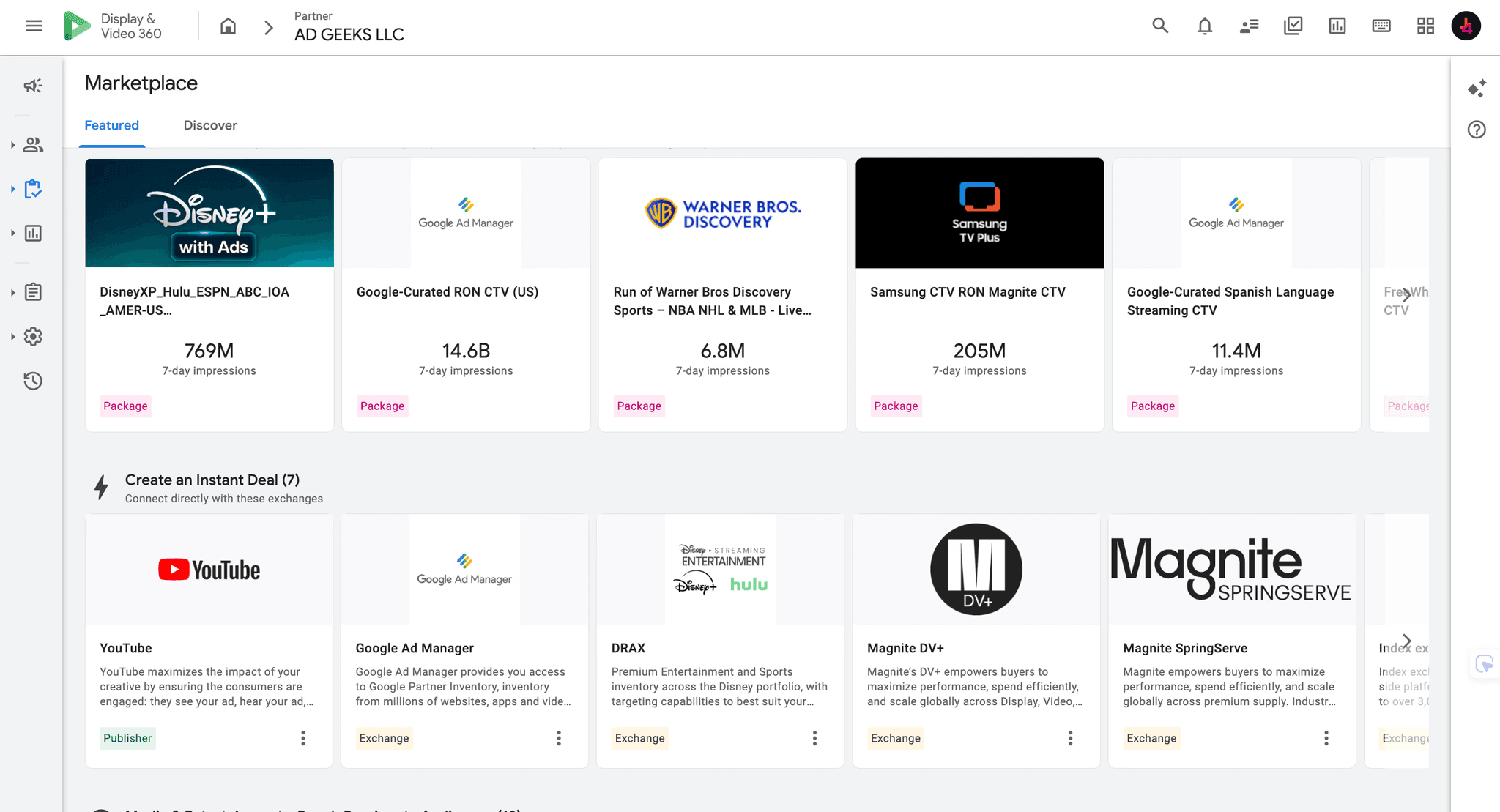
Google’s current Marketplace documentation describes DV360 as a central place for discovering publishers, packages, partner deals and private deals, including inventory across formats such as CTV, video and audio.
Source: Google DV360 - Marketplace overview
For CTV, Google also provides a dedicated Connected TV insertion-order workflow designed around TV and over-the-top inventory.
Source: Google DV360 - Create a Connected TV insertion order
For audio, DV360 provides dedicated audio line items and supports open-auction and deal-based audio inventory, subject to format-specific limitations.
Source: Google DV360 - Purchase audio inventory
A provider should evaluate inventory based on the campaign goal, scale, cost, supply quality, audience availability, brand suitability and measurement requirements.
Private or premium inventory is not automatically better than open-auction inventory.
The provider should explain why each supply path earns budget.
5. Budget, pacing and bidding
A managed team should monitor whether budget is being spent at the intended rate and whether the campaign can realistically deliver within its flight.
That includes:
budget allocation;
spend-to-date;
remaining budget;
insertion-order pacing;
line-item allocation;
bid strategy;
KPI target;
inventory availability;
deal pricing;
audience scale.
The right optimization cadence depends on campaign size, duration, spend, conversion volume and market conditions.
Monitoring can be frequent without making constant changes.
Active campaign management is not the same as reactive campaign management.
A provider should be able to explain what would trigger an intervention and what evidence would justify waiting.
6. Frequency management
Frequency should be reviewed at more than one campaign level.
Google currently allows frequency caps at campaign, insertion-order and line-item levels. A higher-level cap can constrain lower-level delivery.
Source: Google DV360 - Manage frequency with frequency caps
A managed service should therefore review:
campaign-level caps;
insertion-order caps;
line-item caps;
audience size;
CTV exposure;
reach;
frequency distribution;
whether frequency is restricting spend.
The provider should not judge frequency only from the number entered in one line item.
7. Brand suitability and inventory controls
Brand controls should reflect the advertiser’s actual suitability requirements.
Google’s advertiser-level Brand Controls can include content categories, sensitive-content controls, apps and URLs, channels, keywords, Authorized Sellers and eligible third-party verification services.
Source: Google DV360 - Advertiser brand controls
The managed provider should know:
which controls are required;
where they are applied;
which settings are inherited;
whether exclusions are reducing scale;
whether third-party verification is part of the scope.
Brand suitability should be intentional.
It should not be a collection of inherited settings that no one has reviewed.
8. Creative QA
Even when creative production is not included, technical creative QA should have a clear owner.
Before launch, the managed team should confirm:
assets are approved;
dimensions and formats match inventory;
landing-page URLs work;
click tracking works;
video specifications are correct;
creative is assigned to the right line items or deals;
enough variations exist for the plan;
replacement responsibility is clear.
The service agreement should distinguish between:
original creative production;
creative adaptation;
resizing/versioning;
technical QA;
trafficking;
post-launch creative analysis.
Do not assume “creative support included” means full production.
9. Launch QA
Small setup errors can become expensive once the campaign starts spending.
Before launch, a managed provider should check:
Area | Validation question |
|---|---|
Budget & dates | Do campaign, IO and line-item settings match the approved media plan? |
Pacing | Can the setup realistically deliver within the flight? |
Targeting | Are audiences, geographies, devices and exclusions correct? |
Inventory | Are supply sources, packages and deals intentional? |
Frequency | Are caps set at the correct levels? |
Creative | Are assets approved, assigned and eligible? |
Measurement | Are tracking and conversion requirements ready? |
Brand controls | Are the agreed suitability settings active? |
Use the 86-point DV360 Audit Checklist as a deeper second-pass QA framework before major launches and when performance deteriorates.
10. Optimization and troubleshooting
A managed service should have a repeatable diagnostic process.
When performance or delivery changes, the provider should ask:
Is the campaign spending and pacing correctly?
Is inventory delivering the expected scale and quality?
Are audiences large enough and aligned with the objective?
Are creative and approval status affecting delivery?
Are frequency or brand controls restricting scale?
Are deals eligible and delivering?
Is measurement working?
Is the actual KPI improving or deteriorating?
Examples of signals that should trigger investigation include:
sustained underdelivery;
unexpected CPM movement;
excessive frequency;
low viewability;
creative rejection;
weak video completion;
conversion deterioration;
audience saturation;
tracking problems;
deal-delivery failure;
geography mismatch;
publisher concentration.
For deeper diagnostics, see the Display and Video Campaign Underperformance Audit and Programmatic Campaign Delivery Fixes for Agencies.
11. Reporting and decision-making
A dashboard alone is not a managed service.
A useful report should answer:
What happened?
Why did it happen?
What action did the team take?
What should happen next?
Reporting should match the objective, but a typical managed campaign may include:
spend and pacing;
impressions and reach;
frequency;
CPM;
viewability;
video outcomes;
conversions;
CPA or ROAS where relevant;
campaign / IO / line-item breakdowns;
market;
device;
audience;
inventory;
creative.
The provider should also maintain a clear record of major optimization decisions.
If an automated dashboard is part of the reporting workflow, see DV360 to Data Studio (Formerly Looker Studio).
For KPI selection, see DV360 Reporting Metrics That Really Matter.
How often should a managed DV360 campaign be reviewed?
There is no universal cadence that is correct for every account.
The frequency should reflect:
campaign spend;
flight length;
delivery pace;
conversion volume;
objective;
inventory type;
market volatility;
deal requirements;
measurement latency.
A high-spend launch may require several checks during the day.
A lower-spend awareness campaign may need regular monitoring without daily structural changes.
The service should therefore define both:
Monitoring cadence - how often the team checks campaign health.
Intervention rules - what conditions justify changing bids, budgets, audiences, inventory or creative.
Those are not the same thing.
How much does DV360 managed service cost?
There is no universal managed-service price.
Commercial models vary by provider, market, media spend, campaign scope and service level.
Common structures can include:
percentage of media spend;
fixed management fee;
platform or access fee plus management fee;
monthly minimum fee;
project or setup fee;
blended commercial model.
Do not compare only the headline management percentage.
Request an all-in cost model.
Cost question | Why it matters |
|---|---|
Is DV360 access included? | Access and management may be separate commercial components |
Is onboarding/setup included? | Initial account and measurement work can change first-month cost |
Is creative included? | Technical QA, adaptation and original production are different scopes |
Are data costs separate? | Optional audience or data inputs can affect economics |
Is verification separate? | Third-party measurement or suitability services can add cost |
Is reporting included? | Dashboard access and strategic analysis are not the same service |
Is tracking support included? | Measurement implementation may require additional resources |
Is there a minimum term or commitment? | Flexibility varies by provider and agreement |
What happens if media spend changes? | Percentage and minimum-fee models behave differently |
Any provider quoting a fee should define:
currency;
period;
market;
media-spend assumption;
included services;
excluded third-party costs;
minimum commitment;
cancellation or exit terms.
What should you ask before signing a managed-service agreement?
Keep the questions focused on the operating model.
Ask:
Who will manage the campaign day to day?
What access and visibility will our team receive?
Which responsibilities belong to the provider and which remain with us?
How will campaigns, insertion orders and line items be structured?
How often will campaign health be monitored?
What triggers optimization or escalation?
Which inventory and deal types are relevant to our brief?
What creative production, adaptation and QA are included?
What does the all-in commercial model include and exclude?
How are measurement responsibilities divided?
What reporting, commentary and review cadence will we receive?
Can the operating model change later?
What happens to history, reporting, audiences and access if the relationship ends?
For a deeper provider-vs-provider evaluation framework, including platform expertise, creative capability, cross-channel planning and reporting depth, read Comparing DV360 Campaign Management Services.
That page should remain the detailed provider-comparison resource; this guide is focused on what the managed operating model itself should contain.
What should remain with the advertiser?
Managed service does not remove the advertiser from the process.
The advertiser should still own or explicitly approve:
business objectives;
success criteria;
budget;
market priorities;
brand and product strategy;
creative positioning;
conversion definitions;
legal and privacy requirements;
major reallocations;
material commercial decisions.
The provider should own the programmatic responsibilities stated in the agreement.
The advertiser should own the business problem.
The best managed-service relationships make that division explicit.
How AdGeeks approaches DV360 managed service
AdGeeks supports managed, self-service and hybrid DV360 operating models.
Depending on the agreed scope, managed support can include:
campaign architecture;
audience and inventory planning;
campaign setup;
eligible YouTube, premium video, Connected TV and audio activation;
deal workflows;
technical QA;
pacing;
optimization;
reporting;
troubleshooting.
Advertisers that already have programmatic expertise can choose a model with more direct control.
Hybrid arrangements can keep strategy and final budget decisions with the advertiser while assigning technical setup and day-to-day execution to the AdGeeks team.
Review AdGeeks’ programmatic case studies or explore DV360 access and service options.
Frequently Asked Questions
What is DV360 managed service?
DV360 managed service is an operating model in which a provider runs some or all Display & Video 360 campaign activity for an advertiser. Scope can include strategy, setup, audience and inventory planning, media buying, optimization, technical QA, troubleshooting and reporting.
What is the difference between DV360 access and managed service?
DV360 access provides the platform environment under the applicable account and commercial arrangement. Managed service adds execution responsibility, people, processes and ongoing campaign management.
Is managed DV360 better than self-service?
Not automatically. Managed service is useful when the advertiser needs specialist trading capacity or operational support. Self-service can be more efficient for an experienced internal team with established QA, measurement, reporting and troubleshooting processes.
What is hybrid DV360 management?
Hybrid management splits responsibilities between the advertiser and provider. For example, the advertiser may own strategy and budget approval while the provider handles campaign build, technical setup and daily trading.
What should a DV360 managed service include?
A complete engagement can include strategy, campaign architecture, audience and inventory planning, setup, bidding, budget and pacing management, creative QA, brand controls, deals, optimization, troubleshooting, reporting and recommendations.
How much does DV360 managed service cost?
There is no universal price. Cost depends on provider, market, media spend, campaign scope, service level and commercial terms. Compare the all-in cost rather than only the headline management fee.
Does managed DV360 include creative production?
Not always. The contract should state whether the provider offers original production, adaptation, resizing, technical QA only or no creative service.
How often should a managed DV360 campaign be optimized?
There is no universal schedule. Monitoring and intervention frequency should reflect spend, campaign duration, delivery volume, conversion volume, inventory and the time required to evaluate changes.
What should DV360 reporting include?
Reporting should cover relevant campaign KPIs and diagnostic dimensions, explain what changed and why, document actions taken and identify the next decisions.
Can I move from managed DV360 to self-service later?
Potentially. The path depends on account, access, commercial, data and ownership arrangements. If transition is a goal, define visibility, history, audience access, reporting and exit terms before launch.
How should I compare DV360 managed-service providers?
Use a consistent evaluation process and validate platform expertise, creative capability, cross-channel planning, reporting depth and operational accountability. For the dedicated framework, read Comparing DV360 Campaign Management Services.